
[The Palace]
An approachable exploration of AI limits, consciousness, and objectivity through a Speculative Realist lens
Introduction
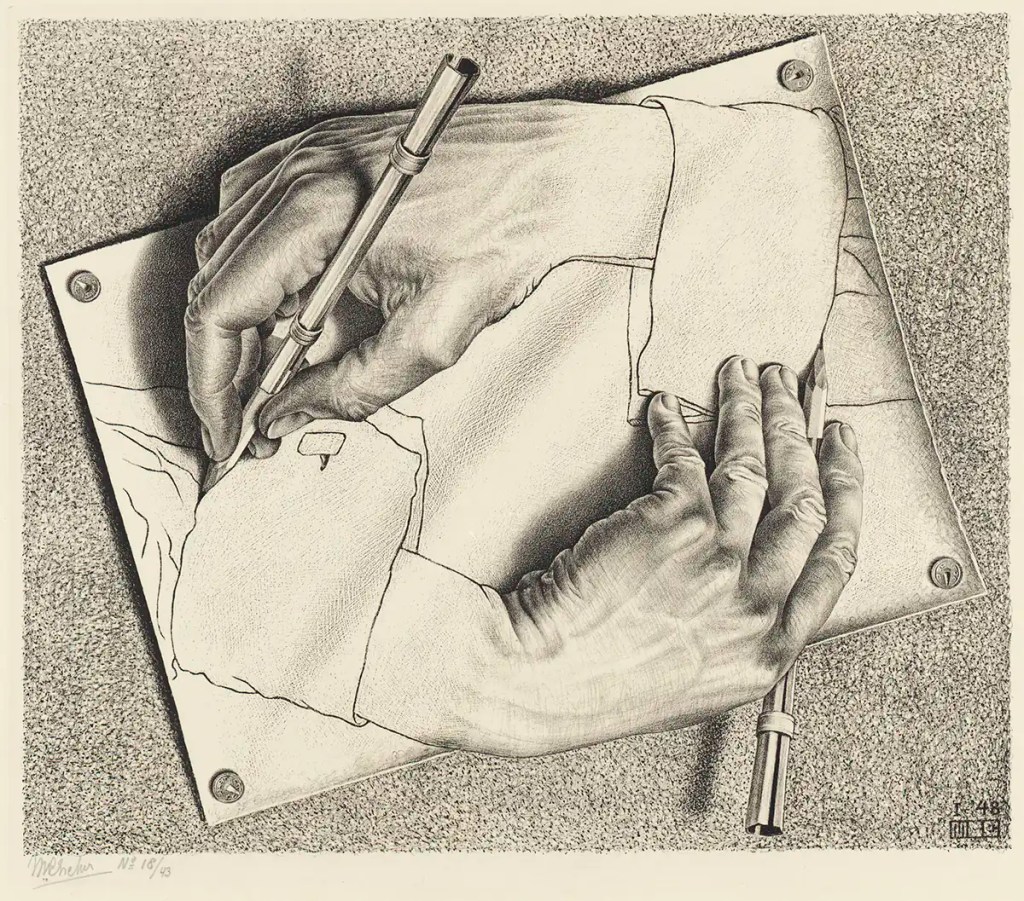
ART—understood here as a broad, generative stance—invites us to see how embodied, sensorial experience, social practice, and cultural formation actively participate in creating objectivity. In this post, ART conversations cross Piaget’s constructivism, Kantian epistemology, and Speculative Realism (especially Object-Oriented Ontology, OOO), with Roger Penrose’s noncomputable approach to consciousness and cosmology. An Escher engraving anchors the dialogue, illustrating observer participation, multi-layer perception, and the paradoxes of appearance and withdrawal. The piece argues that subjectivity, learned through culture and inner motivation, contributes to object formation, while OOO anchors objects in a reality that persists beyond perception. Against this backdrop, we explore AI’s development, the plausibility of Piagetian metaphors for machine learning, and whether AI might converge with or diverge from Penrose’s noncomputable hypothesis—through the lens of ART, Kant, and OOO.
Piagetian constructivism as a lens on AI and ART
Piaget posited that intelligence arises from active interaction with the environment—assimilation, accommodation, and equilibration. Reading ART through the Piagetian lens allows AI to be described as learning via environmental feedback and task-specific challenges, but without the ontogenetic, biologically grounded progression characterising human development. This framing invites a comparative schema: (a) human cognitive-development trajectories vs (b) machine-learning trajectories, and (c) an ontological angle from OOO that treats AI as a structured object with its own withdrawal and agency, independent of human use. Piaget’s constructivist ideas underpin a pedagogical metaphor for AI, rather than a literal reproduction of human development.
Kantian epistemology as a bridging frame
Kant argued that objectivity is mediated by the forms of intuition and the categories of understanding, so knowledge arises from the interaction of sensible data with a priori structures. ART extends this by arguing that concrete subjectivity—embodied, situated, and socially embedded—actively participates in shaping appearances and intelligibility. This moves beyond Kant’s mediation to recognise that bodily engagement and material-cultural practices are constitutive forces in object formation. Reading ART through a Kantian lens preserves the insight that knowledge is structured by cognitive forms while widening the frame to include social-technical mediators as part of the conditions of possible experience.
OOO and the nonhuman dimension
Speculative Realism, especially OOO, holds that objects possess real existence independent of human perception, with withdrawal as a fundamental feature. ART complements OOO by suggesting that humans contribute to object formation through embodied practices, while objects retain their reality and causal influence beyond perception. The synthesis envisions a layered ontology in which human meaning-making operates within a broader network of object relations, without abolishing object reality. The eight-core sources anchor OOO’s withdrawal and objecthood as central motifs.
Penrose: origin, consciousness, and AI limits
Penrose argues for noncomputable elements in consciousness and cosmology, often invoked in Orch-OR (Orchestrated Objective Reduction). ART’s phenomenological orientation aligns with the intuition that conscious experience entails dimensions beyond straightforward computation. The eight-core sources provide a robust ontological-scientific framework for considering noncomputable processes in a world where nonhuman agents and substrates participate in reality. ART and OOO together offer a pluralist landscape for discussing AI, perception, and holistic understanding.
Escher as a visual heuristic
Escher’s Relativity or Drawing Hands epitomise observer participation and the co-constitution of meaning. The image acts as a practical metaphor for ART’s claim that subjectivity is constitutive, not merely ancillary, to objectivity. It also illustrates OOO’s insistence on the real but withdrawn status of objects.
Implications for AI, cognition, and knowledge
AI as metaphorical learner: Piaget’s constructivist lens can be used as a pedagogical metaphor for AI learning paths, rather than literal biological development.
AI as an object in OOO: AI is an object with withdrawal and causal powers in a network of humans, devices, and institutions; ART adds a human-facing layer by embedding subjectivity in the creation and interpretation of AI outputs.
Kant–Piaget–OOO–Penrose synergy: A multi-angled approach to AI that acknowledges conditioning (Kant), construction (Piaget), ontology (OOO), and noncomputable boundaries (Penrose).
Conclusion
The synthesis of Piagetian constructivism, Kantian epistemology, OOO, and Penrose’s noncomputability yields a pluralist, accessible framework for thinking about AI, cognition, and objectivity. ART, as the broad production of subjectivity, links embodied human experience with a nonhuman ontological field in which AI remains an object with its own networked agency. Escher’s illustration anchors the discussion for readers, suggesting that observer participation and the co-creation of meaning are practical as well as philosophical concerns. The post invites readers to wonder whether AI can ever grasp genuine consciousness or holistic understanding—and how knowledge emerges in a world populated by both living and nonliving objects.
+++
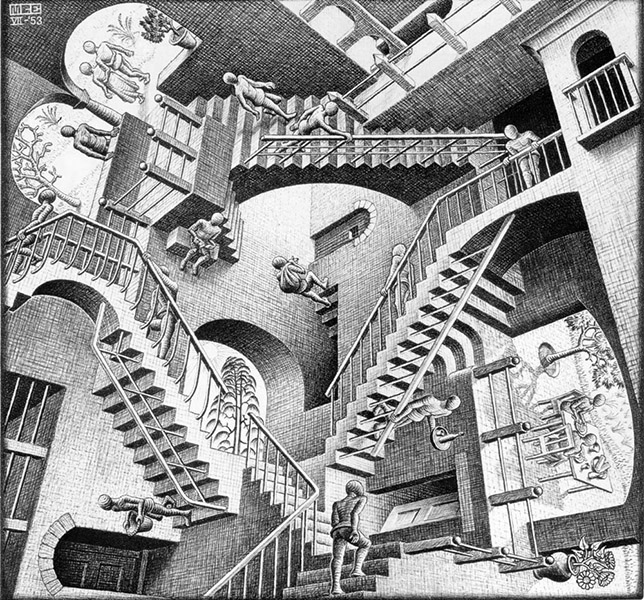
Escher’s Relativity as a visual heuristic for observer participation and the co-constitution of objectivity through perception.
+++
A reader-friendly glossary
ART
A broad generative stance in which embodied subjectivity—sensorial accumulation, learning, conscience formation, Kantian judgment development, culture fostering creativity, and inner will—actively participates in constituting objectivity. It generates objects, perceptions, things, ideas, and emotions beyond conventional art.
OOO
Object-Oriented Ontology: non-human objects have real existence and can exert causal powers independent of human perception; withdrawal denotes epistemic inaccessibility of an object’s full essence.
Withdrawal
The persistence of an object’s reality beyond any observer’s full description or understanding.
Noncomputability
Elements of reality or consciousness that cannot be fully captured by algorithms.
Kantian epistemology
The view that knowledge is structured by the forms of intuition and the categories. Appearances are shaped by these structures.
Piagetian constructivism
Intelligence develops through active interaction with the environment (assimilation, accommodation, equilibration).
Escher as heuristic
Escher’s imagery illustrating observer participation and multi-layer perception, used as a visual metaphor for ART’s claims.
Latour’s science-in-practice
Scientific knowledge emerges through networks of actors, artefacts, and institutions.
One-paragraph ART scope addendum
ART is not a universal property of humankind. It is a dynamic outcome of sensorium, learning, conscience formation, the social construction of Kantian judgment, culturally fertile environments that foster creativity, and inner will—capacities not yet realised by standard AI. It functions as a heuristic for examining how humans and artefacts participate in meaning-making within a broad ontological field, rather than as a universal human trait or as limited solely to artistic production.
Simple eight-source note
Penrose – The Emperor’s New Mind
Penrose – Shadows of the Mind
Harman – The Quadruple Object
Harman – Object-Oriented Ontology
Morton – Hyperobjects; Philosophy and Ecology after the End of the World
Bryant – The Democracy of Objects
Kant – Critique of Pure Reason
Kant – Theory of Judgment
Piaget – The Origins of Intelligence in Children
Escher – Relativity (engraving)
Latour – Reassembling the Social: An Introduction to Actor-Network-Theory
Latour – Laboratory Life: The Construction of Scientific Facts
+++
NOTE — this flash essay is the result of my first interaction with scite.ai. What cannot be explained may exist, though not spoken, which means that reality is and always will be a vaster universe than knowledge. ART is the human agency that objectifies this gap through concrete subjectivity.
António Cerveira Pinto, 11 May 2026

