
The case of Elsa Plotz

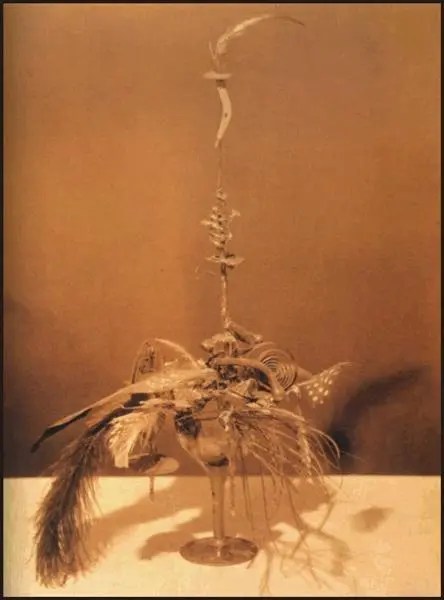
Photograph by Alfred Stieglitz
THE EXHIBIT REFUSED BY THE INDEPENDENTS
« Une réplique, appropriée par Marcel Duchamp (1887-1968), d’un original présenté à la Société des artistes indépendants de New York en avril 1917.»
Could this be Fountain’s new museum label?
« Raconte ce détail à la famille : les indépendants sont ouverts ici avec gros succès. Une de mes amies sous un pseudonyme masculin, Richard Mutt, avait envoyé une pissotière en porcelaine comme sculpture. Ce n’était pas du tout indécent, aucune raison pour la refuser. Le comité a décidé de refuser d’exposer cette chose. J’ai donné ma démission et c’est un potin qui aura sa valeur dans New York. J’avais envie de faire une exposition spéciale des refusés aux Indépendants. Mais ce serait un pléonasme ! Et la pissotière aurait été « lonely ». à bientôt affect. Marcel »
— Duchamp’s letter to her sister Suzanne Duchamp (April 11, 1917).
How come that “the most influential piece of modern art”, a public men’s urinal signed R. Mutt, apparently sent by some Richard Mutt to the great inaugural show of modern art in America, opened in New York City on the evening of April 10 of 1917, has been rejected and disappeared before any chance of being exposed to any public audience?
Fountain’s authorship is a mystery, probably a calculated one by Marcel Duchamp himself. No one knows for sure. Writers and scholars claim, since 2002, that the famous virtual artwork was a ‘readymade’ by Elsa Baroness von Freytag-Loringhoven, attributed to Duchamp by André Breton in 1935. Duchamp finally assumed the Fountain’s authorship in 1950, thirty-three years after its submission to the “First Annual Exhibition of The Society of Independent Artists in 1917.
The so-called Fountain is a non-existent artwork — a virtual entity and a purely conceptual object that has defined contemporary art for almost a century.
Duchamp’s commercial replicas of a similar urinal under the title “Fountain” are indeed copies, iterations, of the original ‘object’ sent to the New York exhibition by someone under the pseudonymous R. Mutt. Above all, the Fountain is the title of a printed picture from a photographic composite image by Alfred Stieglitz specially made for the avantgarde magazine issue n.2 of The Blind Eye (May 1917). So what we have from the year of the exhibition is an image printed on a magazine of an art object (a ‘readymade’) and a title: Fountain. This title and the corresponding picture of the lost thing is the ‘ekphrasis’ of one of the most robust paradigms of twenty-century art. Who made this object? Who found (or ordered) this ‘readymade’? As dictated by André Breton in 1935, eighteen years after the obscure event of its presentation and disappearance, was Marcel Duchamp. But no, or at least not him alone. Alfred Stieglitz did a composite picture of the rejected men’s urinal for The Blind Man — a Dada publication conceived by Duchamp, Henry-Pierre Roché and Beatrice Wood, who became its publisher. Last but not least, R. Mutt’s signature on the top-right border of the urinal suggests that it was Elsa Baroness von Freytag-Loringhoven who signed the artwork and, most probably, the one who ordered and sent the ‘sculpture’ to the great exhibition of the Independents (1). Eight years after her death (1927), Fountain became the most famous readymade.
If this is true, multiple shadows would permanently taint Duchamp’s originality.
A compilation of the most relevant writings proving and disproving Duchamp’s authorship of the Fountain follows, plus a link to Elsa Plotz’s poetry anthology.
This post derives from a recent discussion with my friend and artist Natalia de Mello, whom I vividly thank.
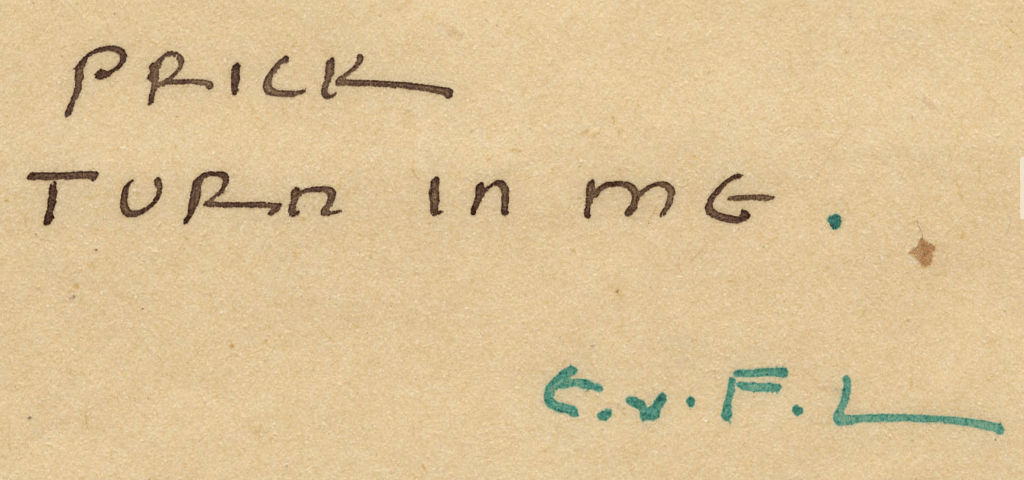
1—The Rs in Elsa’s handwriting don’t fit R. Mutt’s signature.
A C-P
Brussels, Mon 5, Jun 2023.
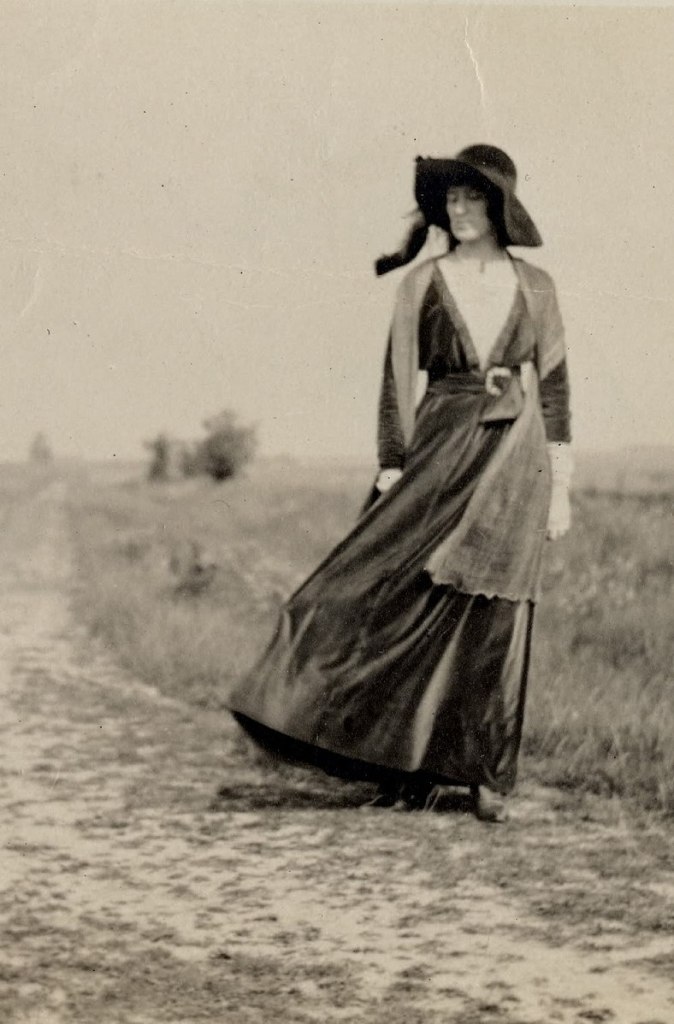
Photographer unknown (probably before 1923)
Elsa Baroness von Freytag-Loringhoven (born Else Hildegard Plötz; (12 July 1874 – 14 December 1927) was a German-born avant-garde visual artist and poet, who was active in Greenwich Village, New York, from 1913 to 1923, where her radical self-displays came to embody a living Dada. She was considered one of the most controversial and radical women artists of the era — Wikipedia.
Seeing in the dark
Below is a compilation of relevant texts published on the controversial relationship between Elsa Plötz and Marcel Duchamp.
(2002)
¶¶¶
“Limbswishing Dada in New York Baroness Elsa’s Gender Performance”
Irene Gammel
With me posing [is] art—aggressive—virile—extraordinary—invigorating—antestereotyped—no wonder blockheads by nature degeneration dislike it—feel peeved—it underscores unreceptiveness like jazz does.
The Baroness to Peggy Guggenheim, 1927Felix Paul Greve […] hat intellektuellen Ehrgeiz—Aber er will ‘Originalitat’—von der ist er strikter Antipod. Ich bin das—was er nicht ist. So musste er mich hassen—lassen.
The Baroness, “Seelisch-chemischebetrachtung”1
Celebrating her posing as virile and aggressive art in the first epigraph, the Data artist Elsa von Freytag-Loringhoven, nee Plotz (1874-1927) summed up her remarkable life and work just months before her mysterious death in Paris. Known as the Baroness amongst the international avant-garde in New York and Paris of the teens and twenties, the German-born performance artist, model, sculptor, and poet was a party to the general rejection of sexual Victorianism, launched with the 1913 International Exhibition of Modern Art, the so-called Armory Show, in Manhattan. Before coming to New York, the Baroness had undergone a picaresque apprenticeship amongst the Kunstgeiuerbler avant-garde in Munich and Berlin from around 1896 to 1911, before following her long-time spouse Felix Paul Greve (aka F.P. Grove) on a quixotic immigration adventure to Kentucky. After Grove’s desertion, she made her way to New York and promptly married the impe-cunious (but sexually satisfying) Baron Leopold von Freytag-Loringhoven. Soon a tided war widow (the Baron was incarcerated by the French in 1914 and committed suicide in 1919), the Baroness claimed her new spiritual home amidst an energetic and international group of vanguard artists– many of them exiles from Europe. From 1913 on, she threw herself with abandon into New York’s experimental ferment, quickly becoming the movement’s most radical and controversial exponent.2
(…)
Canadian Review of Comparative Literature/Revue Canadienne de Littérature Comparée CRCL JANUARY-MARCH 2002 MARS-JUIN
0319-051X/2002/29.1/1 © Canadian Comparative Literature Association
https://journals.library.ualberta.ca/crcl/index.php/crcl/issue/view/671
¶¶¶
The Mama of Dada
By Holland Cotter
NYT, May 19, 2002
The Baroness Elsa von Freytag-Loringhoven (1874-1927) — known to her amused, admiring, often quailing friends simply as the Baroness — was a public event, a proto-Happening. She painted her shaved head red. She wore a tomato-can bra, a bustle with a taillight and a bird cage around her neck with live canaries inside. The streets of New York were her theater. Dada was the name of her act.
Many people who watched her clanking imperiously through Greenwich Village in the years just after World War I probably took her for only another New York nut job; until recently, history has done that too. But she was also an artist, a poet, a voluble fixture of the cultural avant-garde and a guerrilla fighter in sexual politics. This is how she comes across in Irene Gammel’s ‘‘Baroness Elsa,’’ the first full account of the Baroness’s life. It attempts, on the whole persuasively, to position her as a catalytic figure in the American art of her day and in the evolution of certain more contemporary forms — junk art, performance art, body art.
…
Elsa came into her own as part of the New York Dada scene. Her sexual fieldwork continued, with many successes and a few notable disappointments. She developed a crush on Marcel Duchamp, who responded with passive evasion. (‘‘Marcel, Marcel, I love you like hell, Marcel’’ was her cri de coeur.)
(…)
She started to make art: painted portraits, witty, delicate sculptures of found materials and assemblage-style costumes. Her beyond-the-fringe daring was a power of example for her male colleagues — the wannabe Dadaist Ezra Pound spoke approvingly of her ‘‘principle of nonacquiescence’’ — and may have produced collaborative results. Ms. Gammel presents strong evidence that the Baroness supplied Duchamp with the urinal from which his groundbreaking ‘‘Fountain’’ was made, and provided the prototype for his cross-dressed Rrose Selavy.
¶¶¶
Baroness Elsa
Gender, Dada, and Everyday Modernity-A Cultural Biography
Irene Gammel
MIT Press, 2002
The first biography of the enigmatic dadaist known as the Baroness–Elsa von Freytag-Loringhoven.
Elsa von Freytag-Loringhoven (1874-1927) is considered by many to be the first American dadaist as well as the mother of dada. An innovator in poetic form and an early creator of junk sculpture, the Baroness was best known for her sexually charged, often controversial performances. Some thought her merely crazed, others thought her a genius. The editor Margaret Anderson called her perhaps the only figure of our generation who deserves the epithet extraordinary. Yet despite her great notoriety and influence, until recently her story and work have been little known outside the circle of modernist scholars.
In Baroness Elsa , Irene Gammel traces the extraordinary life and work of this daring woman, viewing her in the context of female dada and the historical battles fought by women in the early twentieth century. Striding through the streets of Berlin, Munich, New York, and Paris wearing such adornments as a tomato-soup can bra, teaspoon earrings, and black lipstick, the Baroness erased the boundaries between life and art, between the everyday and the outrageous, between the creative and the dangerous. Her art objects were precursors to dada objects of the teens and twenties, her sound and visual poetry were far more daring than those of the male modernists of her time, and her performances prefigured feminist body art and performance art by nearly half a century.
https://www.standaardboekhandel.be/p/baroness-elsa-9780262572156?utm_source=pocket_saves
¶¶¶
“My Heart Belongs To Dada”
By René Steinke
Aug. 18, 2002
The New York Times Magazine
(…)
She had a tall, lithe frame, ‘‘very Gothic,’’ and ‘‘a wonderful gait,’’ according to the photographer Berenice Abbott. Her fierce, strange beauty and her predilection for taking off her clothes made her a favorite model for artists like Robert Henri, William Glackens and Man Ray. But even before coming to New York, as she spent her youth chasing an ambition to become a ‘‘real free true lady artist,’’ the Baroness played the part of model and muse. As a young runaway in Berlin, she posed as a living statue at the Wintergarten Theater, in a kind of live pornography show disguised as edifying classical art.
(…)
If Duchamp was right about the Baroness being the future, her time may now have arrived. The Francis M. Naumann Fine Art gallery recently devoted an exhibition to her, and a new biography (‘‘Baroness Elsa,’’ by Irene Gammel) finally establishes her rightful place as the first American performance artist. Now that it is practically impossible not to wear mass-produced clothing, encouraging women to hire stylists to make themselves look different, there is enormous appeal in the Baroness’s surreal ensembles.
(…)
The opposite of the passive model, the Baroness was Duchamp’s ‘‘Nude Descending a Staircase’’ come to life and strolling out the door. In 1921, she starred in a film made by Duchamp and Man Ray, titled ‘‘Elsa, Baroness von Freytag-Loringhoven, Shaving Her Pubic Hair.’’ In the two frames that remain (Man Ray accidentally destroyed the film during development), she appears to be dancing, spectacularly naked, after the barber has done his work.
¶¶¶
“Baroness Elsa and the Aesthetics of Empathy A Mystery and a Speculation”
Richard Cavell
On April 1st, 1921, the Socieété Anonyme of New York, which was the first American society devoted to the presentation of modern art, held a session on Dada which was immortalized in a drawing by Richard Boix (figure 5). In this draining we find a number of key figures within New York Dada, including Man Ray and Marcel Duchamp, all of whom are clearly identified by name. In the centre of the image, however, there is a figure resting on a pillar identified only as “La Femme,” and it is around this figure that a mystery has grown up (figure 6). The New York Dada scholar Francis Naumann has suggested an identification with a sculpture by Archipenko (figure 7), while admitting that “no specific sculpture by Archipenko—nor, for that matter, any other artist from this period—exhibits the unusual details that can be found in this illustrator’s flight of fancy” (“New York Dada” 14). Identifying the figure with Eve through the icon of the apple, Naumann notes contrariwise that from the “string attached to the woman’s elbow (or is it a beaklike extension of her nose?) a cup dangles freely in space, a detail that makes the sculpture look less like the depiction of a woman and more like an organ-grinder’s monkey ‘gone Dada’” (14). In the mystery of this figure Naumann sees the very reason why “people keep asking ‘what is Dada?’”
In the decade from 1986, when Rudolf Kuenzli published New York Dada, to 1996, when Francis Naumann issued “Making Mischief: Dada Invades New York”, the figure of Baroness Elsa von Freytag-Loringhoven has moved from the peripheries of New York Dada to occupy a central position, as the reproduction of her 1920 Portrait of Marcel Duchamp on the cover of Naumann’s book tellingly indicates (figure i). The reasons for this shift are many: one has to do with the increasing recognition of the historical importance of women in Dada (as in the anthology of articles recently edited by Naomi Sawelson-Gorse). Closely connected to this avenue of approach is that of feminist theory, which, by critiquing the notion of Dada as an exclusively masculinist activity, has opened up a space for important figures such as Elsa to emerge from obscurity. Another avenue along which Elsa studies have developed is that of sexuality: Elsa’s memoirs, published by Paul Hjartarson and Douglas Spettigue under the title Baroness Elsa, remain among the most breathtakingly frank documents of this period, and we are now beginning to understand that sexuality was absolutely central to Elsa’s art, be it her poetry, her prose or the artefacts she created. Finally, the growing interest in and research on Elsa’s German partner, Felix Paul Greve, has been accompanied by the realisation that their work constitutes much more of an intellectual 1
(…)
Canadian Review of Comparative Literature/Revue Canadienne de Littérature Comparée CRCL JANUARY-MARCH 2002 MARS-JUIN
0319-051X/2002/29.1/1 © Canadian Comparative Literature Association
https://journals.library.ualberta.ca/crcl/index.php/crcl/issue/view/671
(2004)
¶¶¶
“Work of art that inspired a movement … a urinal”
Charlotte Higgins, arts correspondent
The Guardian, Thu 2 Dec 2004 12.12 GMT
A humble porcelain urinal – reclining on its side, and marked with a false signature – has been named the world’s most influential piece of modern art, knocking Picasso and Matisse from their traditional positions of supremacy.
Marcel Duchamp’s Fountain, created in 1917, has been interpreted in innumerable different ways, including as a reference to the female sexual parts.
However, what is clear is the direct link between Duchamp’s “readymade”, as the artist called it, and the conceptual art that dominates today – Tracey Emin’s Bed being a prime example.
According to art expert Simon Wilson, “the Duchampian notion that art can be made of anything has finally taken off. And not only about formal qualities, but about the ‘edginess’ of using a urinal and thus challenging bourgeois art.”
The Duchamp came out top in a survey of 500 artists, curators, critics and dealers commissioned by the sponsor of the Turner prize, Gordon’s. Different categories of respondents chose markedly different works, with artists in particular plumping overwhelmingly for Fountain.
https://www.theguardian.com/uk/2004/dec/02/arts.artsnews1
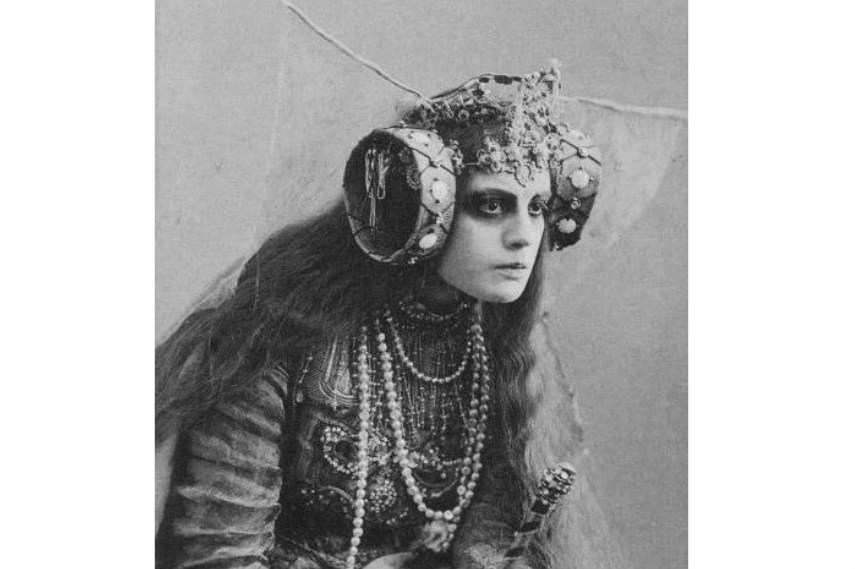
(author and date unknown)
[2008]
¶¶¶
In Transition: Selected Poems [1923-1927]
by the Baroness Elsa von Freytag-Loringhoven
https://digital.lib.umd.edu/transition/index.html
[2011]
¶¶¶
Body Sweats: The Uncensored Writings of Elsa Von Freytag-Loringhoven
by Elsa Von Freytag-Loringhoven
Mit Press (2011)
The first major collection of poetry written in English by the flabbergasting and flamboyant Baroness Elsa, “the first American Dada.”As a neurasthenic, kleptomaniac, man-chasing proto-punk poet and artist, the Baroness Elsa von Freytag-Loringhoven left in her wake a ripple that is becoming a rip–one hundred years after she exploded onto the New York art scene. As an agent provocateur within New York’s modernist revolution, “the first American Dada” not only dressed and behaved with purposeful outrageousness, but she set an example that went well beyond the eccentric divas of the twenty-first century, including her conceptual descendant, Lady Gaga.Her delirious verse flabbergasted New Yorkers as much as her flamboyant persona. As a poet, she was profane and playfully obscene, imagining a farting God, and transforming her contemporary Marcel Duchamp into M’ars (my arse). With its ragged edges and atonal rhythms, her poetry echoes the noise of the metropolis itself. Her love poetry muses graphically on ejaculation, orgasm, and oral sex. When she tired of existing words, she created new ones: “phalluspistol,” “spinsterlollipop,” “kissambushed.” The Baroness’s rebellious, highly sexed howls prefigured the Beats; her intensity and psychological complexity anticipates the poetic utterances of Anne Sexton and Sylvia Plath.Published more than a century after her arrival in New York, Body Sweats is the first major collection of Elsa von Freytag-Loringhoven’s poems in English. The Baroness’s biographer Irene Gammel and coeditor Suzanne Zelazo have assembled 150 poems, most of them never before published. Many of the poems are themselves art objects, decorated in red and green ink, adorned with sketches and diagrams, presented with the same visceral immediacy they had when they were composed.
(2013)
¶¶¶
“The Hits of Lady Dada : Baroness Elsa von Freytag-Loringhoven”
By Ben Robinson
Yuck ‘n Yum Winter 2013
Whether in art, politics, love or warfare, history is said to be written by the victors. The importance of Marcel Duchamp’s 1917 Fountain is surely beyond any doubt, having changed the entire art historical narrative irrevocably. In 2004, to no-one’s great surprise, it was voted the most influential artwork of the 20th century by 500 selected art world professionals. This article is not about to argue any different. But what if Fountain, that most influential artwork, was maybe the idea of someone else entirely, someone whose place in art history was largely forgotten and has only recently come to light?
In a 1917 letter from Duchamp to his sister Suzanne, he informed her that his submission to the Society of Independent Artists was in fact conceived by a friend:
“One of my female friends who had adopted the pseudonym Richard Mutt sent me a porcelain urinal as a sculpture; since there was nothing indecent about it, there was no reason to reject it.”
So could this mysterious friend have been Baroness Elsa von Freytag-Loringhoven, and who was she anyway?
The Baroness was born in 1874 in Pomerania, Germany, and spent much of her early life as an actress and vaudeville performer. She had numerous affairs with artists in Berlin, Munich and Italy, studied art in Dachau, and married an architect in Berlin in 1901. This marriage became a ménage à trois with the poet and translator Felix Paul Greve, and in 1910 she emigrated to America with him. On moving to New York in 1913 she married the German Baron Leopold von Freytag-Loringhoven, got a job in a cigarette factory, and fell in with the city’s nascent Dada scene. Baron von Loringhoven hurried back to Germany at the outbreak of war, where he shot himself – an act which his wife characterised as the “bravest of his life”.
Freytag-Loringhoven cut an eccentric figure on the New York streets with her shaved head, black lipstick and riotous outfits of found-object ensembles, among them a tomato-can bra, a birdcage hat with live canary, and postage stamps pasted to her cheeks. She modeled for artists including Man Ray, and appeared in a short film by Ray and Duchamp titled The Baroness Shaves Her Pubic Hair. She wrote poetry that was published in the Little Review and inspired Ezra Pound, who wrote in his Cantos that the Baroness lived by a “principle of non-acquiescence.” While pursuing a thorough dismantling of the boundaries between art and everyday life, she created artworks whose existence has survived through many years of obscurity. The irreligious Dada object God is a 10½ inches high cast iron plumbing trap turned upside down and mounted on a wooden mitre box, a 1917 readymade that’s contemporaneous with Fountain and is now exhibited alongside it in the Arensberg Collection at the Philadelphia Museum of Art.
After her flowering with New York Dada, Freytag-Loringhoven was cut adrift when many of her fellow artists and poets returned home to Europe after the war. By the time she’d inherited enough money to travel to Paris in 1926, she was in declining health and dismayed by the many rejections of her English-language poetry in her resolutely Francophone new home. A disastrous stay in post-war Berlin came to nothing, though a return to Paris the following year seemed to promise some improved mental stability. However. she was to die alone of gas suffocation in her flat, either by suicide or fatal accident. She is buried at Paris’s Père Lachaise Cemetery.
The Baroness’s place in history might have been condemned to a mere footnote but for a sudden resurgence of interest in this unique Dada trailblazer. In 2003, Irene Gammel’s Baroness Elsa: Gender, Dada, and Everyday Modernity told her extraordinary story in the context of feminist body art and performance art, while Body Sweats: The Uncensored Writings of Elsa von Freytag-Loringhoven was listed by The New York Times as one of the notable art books of 2011. Even her unique and inflammatory fashions have appeared on the catwalks: for spring 2009, Maison Martin Margiela paraded models wearing a collection made entirely of refuse, and in winter 2009 Agatha Ruiz de la Prada took Elsa’s signature birdcage as the design cue for a skirt. The Baroness’s life and work had always defied specific categories, and she foresees junk art, performance art, body art, collage, found sculptures and assemblage by decades. It’s been a long time coming, but Baroness Elsa can finally claim a kind of victory.
https://www.yucknyum.org/zine/winter-2013/5/

God (1915)
(photo: Morton Schamberg)
¶¶¶
Elsa von Freytag-Loringhoven
1874 — Świnoujście, Pologne | 1927 — Paris, France
Sculptrice et poétesse états-unienne.
À 18 ans, Elsa von Freytag-Loringhoven quitte sa famille pour s’installer à Berlin. Après deux mariages ratés, avec l’architecte August Endell en 1901, et avec l’écrivain Felix Paul Greve en 1907, elle s’installe à New York, où elle rencontre le baron Leopold von Freytag-Loringhoven, avec qui elle se marie en 1913. Dans les années 1920, elle devient alors célèbre à Greenwich Village pour ses accoutrements extravagants faits de vêtements artistiques farfelus (corbeille à papier ou seau à charbon en guise de chapeau) et ses comportements excentriques. Pour survivre, elle pose comme modèle pour différents artistes : Theresa Bernstein, George Biddle. Elle commence à faire ses premiers collages et assemblages, le plus souvent à partir d’objets trouvés (comme dans son portrait de Marcel Duchamp, photographié par Charles Sheeler). Elle aime fréquenter les salons avec le crâne rasé, en particulier chez les Arensberg, centre de l’avant-garde artistique et intellectuelle américaine. Nouvelle égérie du mouvement dada de New York, elle est surnommée Dada Baroness. Elle joue dans un film coréalisé par Marcel Duchamp et Man Ray intitulé La Baronne rase ses poils pubiens.
En 1915, elle réalise, avec Morton Schamberg, la sculpture God, formée par un tuyau de plomb sur un morceau de bois, que beaucoup considèrent comme l’expression parfaite du dadaïsme de New York. Dès 1917, elle publie de nombreux poèmes dans les revues littéraires avant-gardistes, Broom, The Liberator et The Little Review qui la consacre « première dada américaine ». Incapable de survivre à New York sans revenus fixes, elle retourne en Allemagne en 1923. En proie à des pulsions suicidaires, elle fait plusieurs séjours dans des hôpitaux psychiatriques. Elle meurt intoxiquée par le gaz dans son appartement parisien. Son autobiographie Baroness Elsa est parue en 1992, réalisée à partir de son manuscrit autobiographique et d’extraits de lettres.
Béatrix Pernelle
Extrait du Dictionnaire universel des créatrices
© 2013 Des femmes – Antoinette Fouque
https://awarewomenartists.com/artiste/elsa-von-freytag-loringhoven/
(2014)
¶¶¶
“How Duchamp stole the Urinal”
November 4, 2014 | By SRB
Scottish Review of Books
Calvin Tomkins met Marcel Duchamp in 1959 when he wrote an article about him for Newsweek. They were friends until the artist’s death in 1968. The Museum of Modern Art has just published a new and revised edition of Tomkins’ now standard 1996 biography of Duchamp. Ann Temkin, Chief Curator of Painting and Sculpture at MoMA, praises Tomkins in her introduction for unfailingly bringing ‘a splendid lightness of touch to the weight of his careful and thorough research.’
Lightness is crucial to Tomkins’ assessment of Duchamp. He criticises those who take Duchamp too seriously. ‘Approach his work with a light heart’, Tomkins recommends, ‘and the rewards are everywhere in sight.’ This affable attitude, which demonstrated a warm friendship, has led Tomkins to brush aside all the recent research that undermines Duchamp’s own account of his life, which Tomkins used as the basis of his biography.
The startling fact has now emerged that Duchamp stole his most famous work, the urinal, from a female artist, robbed it of its original meaning, and turned it into something it was never intended to be: a piss take against the whole of art. This revelation undermines the whole argument of Tomkins’ book, discredits his ‘careful and thorough research’ and changes the history of art.
When the mood took him, Duchamp could be honest about his dishonesty. In an interview for Vogue in 1962, he told William Seitz ‘I insist every word I am telling you now is stupid and wrong.’ Research has now revealed that Duchamp’s account of his life is a hall of smoke and mirrors. But, extraordinarily, there is a ‘smoking gun’ in all this subterfuge, and Duchamp is holding the incriminating weapon himself.
On April 11, 1917, just two days after the directors of the Society of Independent Artists had rejected a urinal as a submission for their exhibition, Duchamp wrote to his sister telling her that ‘One of my female friends under a masculine pseudonym, Richard Mutt, sent in a porcelain urinal as a sculpture’. This letter did not enter the public domain until 1983. It contradicts Duchamp’s own later account of this seminal incident.
In The Complete Works of Marcel Duchamp (1979) Arturo Schwarz reports that Duchamp claimed that he and his friends Walter Arensberg and Joseph Stella went shopping on Fifth Avenue, ‘after a spirited conversation at lunch’, and bought a urinal from the J. L. Mott Iron Works. Duchamp then took it back to his studio, signed it R. MUTT, and submitted it to the Independents exhibition, calling it Fountain.
The board of the Society of Independents, of which Duchamp and Arensberg were members, had decided that they would hang every work of art submitted. Duchamp wasn’t present when the urinal, a late entry, was considered. Arensberg argued that it was art because an artist had chosen it. Mere choice, he claimed, could be transposed to an object and turn it into a work of art. The board, however, voted to reject the item on the grounds that it wasn’t art. Arensberg, and then Duchamp, resigned in protest.
The submission and rejection of Duchamp’s urinal is now regarded as one of the key, early turning points in the history of modern art, on a par with the revolutions of Fauvism and Cubism, De Stijl and Der Blaue Reiter. Fountain is always cited as the source of Conceptualism, the modern art movement that America, rather than Europe, gave the world. In Conceptual Art the idea behind the work is more important than its visual appearance or any aesthetic considerations.
Many leading Duchamp scholars, in particularly William Camfield, Rhonda Roland Shearer and Glyn Thompson, in research published between 1996 and 2008, have discovered that this account of the urinal’s submission is simply not true. Duchamp and his friends couldn’t have bought the urinal from the J. L. Mott Ironworks because they didn’t sell that particular model. And the urinal was submitted untitled. Thompson argues convincingly that it was Alfred Stieglitz who named it Fountain when he photographed the rejected entry later.
The public outrage has also been hugely exaggerated. Since the urinal was never exhibited, no one saw it. Arensberg tried to generate publicity through his modest magazine, Blind Man 2, but there was little interest. Guillaume Apollinaire referred to the incident in the Mercure de France fifteen months later but he dismissed it as a pale American imitation of the famous blague known as the Boronali Affair of 1910 in which some abstract paintings which fooled the critics were later shown to have been made by a donkey’s tail. Japes against modern art were common by this time. They’d begun much earlier in Paris, when in 1883 Alphonse Allais exhibited a sheet of white paper in a frame and called it Anaemic Young Girls at their First Communion in the Snow.
Tomkins ignores all these discoveries in his new edition. He argues that Duchamp wanted (for reasons he doesn’t explain) to keep his involvement in the ‘affair’ of the urinal secret. This was why he pretended in his letter to his sister that a ‘female friend’ had submitted the object. But this explanation makes no sense because his sister, a Red Cross nurse in Paris, had no contacts with the New York media and, anyway, Duchamp’s letter would have taken weeks to arrive in war-torn Europe, long after public interest in the incident had fizzled out. The most obvious explanation is that Duchamp in his letter was telling the truth. But if he was, who then was this ‘female friend’?
The great new addition to the story of Duchamp, besides all the excellent, forensic work by Duchamp scholars, is the research of Irene Gammel. Her enthralling, moving and beautifully paced biography, Baroness Elsa, published in 2002, not only throws a spotlight, for the first time, on a highly influential creative figure in the maelstrom of art at the turn of the century, but radically changes our perception of Duchamp.
Baroness Elsa was born plain Else Plotz in Swinemunde, Germany, in 1874. Her father was a builder and local councilor who philandered freely, beat her mother and, Elsa believed, inflicted her with syphilis. In her poem, Coachrider (c 1924), Elsa wrote:
Look at Papa – Killer!
He beams – lovably – virile – despotic by blood – I adore – abhor him –
Elsa’s mother, Ida, forbidden to play her beloved piano by her husband, retreated into religion and romantic fiction. She insisted that her two daughters pray before they went to sleep. ‘Like going for a pee before bed,’ their atheist father laughed back. Ida attempted suicide and later died in an institution in 1893. As Elsa put it, she ‘left me her heritage … to fight.’
Elsa’s genius was to find new ways to break out of the social straightjacket that bound women in the 19th Century. She turned her life into a theatrical performance in which she could fight her mother’s battles openly, in public, in the street, whenever and wherever she wanted to, not when any man told her she could. Djuna Barnes, a friend late in Elsa’s life, wrote ‘People were afraid of her because she was undismayed about the facts of life – any of them – all of them.’
Gammel unravels the complex threads of Elsa’s marriages, first to the Jugendstil architect August Endell, and then to Felix Paul Greve (later Frederick Philip Grove), the translator of Oscar Wilde, who with Elsa’s helped, faked his own suicide in 1909 to escape his creditors. This event brought her to America a year later.
Her third marriage, in 1913, was to Leopold Karl Friedrich Baron von Freytag- Loringhoven, the impoverished son of a German aristocrat who had, like Felix Greve, fled Europe to escape debts. Soon after the marriage, Leopold vanished with Elsa’s paltry savings. However, he left her with a title and an entrée into the most exclusive artistic circles in New York. The Armory Show had just transformed New York, making it modern and cosmopolitan. The Baroness was soon a habituée of the Arensberg circle, where Duchamp himself held court.
Duchamp’s relationship with Elsa came at a crucial time in both of their lives and merited re-examination in Tomkins’ new edition. But the Baroness is given the same half paragraph as before, once more entertainingly dismissed as a woman ‘unhampered by sanity’. Though Tomkins acknowledges her innovative use of found objects – she sewed ‘flattened tin cans, and other strange talismans’ on to her dress – he doesn’t take her interest in them seriously. Found objects could be works of art for men; for women they were merely decorative fetishes.
The Baroness and Duchamp had studios in the same Lincoln Arcade Building, on 1947 Broadway in1916. According to Elsa, they enjoyed many midnight rendezvous. Elsa’s nickname for Duchamp was m’ars. She loved puns. M’ars was a word play on my arse and Mars, the god of war. She called herself ‘m’ars teutonic’, a female god of war, with, of course, a magnificent German posterior.
The American painter, Louis Bouché, recounted a remarkable incident. He’d bought Elsa a newspaper clipping showing Duchamp’s painting Nude Descending a Staircase. He described the scene: ‘she was all joy, took the clipping and gave herself a rub down with it, missing no part of her anatomy’, while reciting her own poem ‘Marcel, Marcel, I Love You like Hell, Marcel.’
Tomkins just quotes the line but leaves out the context, giving the impression that Elsa was, like many women, besotted with his hero. But, as Gammel correctly observes, Elsa’s ‘engagement with Duchamp was astutely critical.’ The rub down was cleansing as well as erotic; she presumably used the newsprint not just to arouse herself but also to wipe her ‘ars teutonic’.
Nude Descending a Staircase was the painting that had made Duchamp famous in America when it was exhibited at the Armory Show in 1913. Its notoriety had been predictable. Nudes didn’t move, and certainly didn’t come downstairs. The implications were scandalous: nudes in the living room, whatever next!
The year before, the Salon des Indépendants in Paris had rejected the picture not because it was too radical as a work of art but because its title was too provocative. They didn’t want any fuss in the press; they were, by then, trying to establish Cubism as a serious art form. They asked Duchamp to remove the title, but he refused.
The understandable row in the American media, as it happened, proved to be remarkably good-humoured. The American Art News offered a ten-dollar prize for the best poem about the picture, and awarded it to a ditty that ended: ‘You’ve tried to fashion her of broken bits,/ And you’ve worked yourself into seventeen fits;/ The reason you’ve failed to tell you I can,/ It isn’t a lady but only a man.’
There remains a deep ambiguousness about Duchamp’s sexuality. This was most obviously manifested in his female persona, Rrose Selavy, who appeared intermittently from 1920 to 1941, wearing furs and make up. But it also appeared in his art. His female nudes are masculine and mechanical. It was this coldness in Duchamp that Elsa caught in the portrait she painted of him on celluloid. It is now lost but was remembered by the artist George Biddle: she depicted him as an electric light bulb spitting icicles.
This contrasts with Elsa’s own bracing and embracing personality. She inspired all who came into contact with her, from Frank Wedekind to Ezra Pound, Djuna Barnes and Ernest Hemingway. The photographer Berenice Abbott said ‘The Baroness was like Jesus Christ and Shakespeare all rolled into one… perhaps she was the most influential person to me in my early life.’ Elsa became famous in literary circles from 1918 to 1921 when The Little Review presented her poetry side by side with excerpts from James Joyce’s Ulysses.
Visual art was vitally important to Elsa, but hardly any survives. George Biddle described a visit to her studio in October 1917: ‘odd bits of ironware, automobile tiles… ash cans, every conceivable horror, which to her tortured yet highly sensitive perception, became objects of formal beauty… it had to me quite as much authenticity as, for instance, Brancusi’s studio in Paris.’
Irene Gammel, with immaculate scholarly precision, draws together the threads of the circumstantial evidence surrounding the submission of the urinal to the Independents exhibition in 1917 and comes to the conclusion that Duchamp’s mysterious ‘female friend’ was the Baroness. As Elsa’s, the urinal becomes meaningful. Gammel relates it to several incidents in her life, including her father’s comment that saying one’s prayers was the same as taking a piss before bed. The urinal sent to the Independents exhibition, which was essentially a gentleman’s club, was another sally in her mother’s war against her abusive husband. But it was a much richer image than that.
The urinal, amazingly, was one of a pair, one of the very few sculptures by Elsa to survive. This was a U-bend plumbing trap turned upside down and mounted on a carpenter’s mitre block (therefore framing it, by punning implication, in religion). It looked like a metal ‘g’ and Elsa called it God.
God in one of Elsa’s poems is described as being ‘densely slow – He has eternity backing him’. If god is everywhere, as many believers maintain, he has to be in the most despised corners – in a U-bend to catch blocking waste that could have once been plumbed into a urinal.
Elsa’s sculpture God, however, could also be a portrait of Duchamp. She wrote ‘m’ars [Duchamp] came to this country – protected – by fame – to use his plumbing features – mechanical comforts – He merely amused himself. But I am m’ars tuetonic… I have not yet attained his heights. I have to fight.’ If God is Duchamp, a bent pipe, then the urinal could be a self-portrait. Laid on its back, it takes the form of a womb cradled in a pelvic girdle that could have received Duchamp’s sperm.
America’s declaration of war on Elsa’s beloved Germany on Good Friday 6th April 1917 could have been the trigger that made the spontaneous Elsa submit the urinal, as a late entry, to the Independents exhibition in New York. It would normally have taken three hours to send by train from Philadelphia, where she was living at that time, but the Easter weekend meant that the urinal didn’t arrive at the Independents until Monday, 12 days after submissions had closed.
Elsa didn’t title the urinal but signed it R. Mutt in a script close to the one she sometimes used for her poems, but which is unrelated to Duchamp’s handwriting. R. Mutt, Gammel explains, is a pun on Urmutter, the German Earth Mother whom Elsa’s symbolist friends had adulated in Munich in 1900. R. Mutt could also have been a pun on armut, meaning poverty, Elsa’s own material poverty and the poverty of American culture, which she frequently railed against. And Elsa’s favourite expletive was shitmutt. Everything fitted. The urinal was Elsa’s declaration of war against war, praise for her motherland, and her challenge to the privileged, aloof, sexually ambivalent Duchamp.
The only evidence that survives of the original urinal is the photograph Alfred Stieglitz took of it for Arensberg’s Blind Man 2 magazine. He lit it carefully so that the shadow within the urinal forms the profile of a pristine white, veiled Madonna – Elsa’s and his own German motherland is being fired at. Even more pointedly, as Glyn Thompson has pointed out, Stieglitz chose to photograph the urinal against the American Modernist Marsden Hartley’s painting Warriors, which was not hanging in his gallery at the time but had to be taken out of the storeroom. Warriors was Hartley’s hymn to the German military manhood. Stieglitz, an American German Jew, by photographing them together, identified the urinal with pro-German feeling as America went to war. Stieglitz did not take photographs casually. This suggests that he knew who had submitted the urinal and what it meant.
Gammel, bamboozled as so many have been by the towering status of Duchamp, does not go so far as to suggest that the urinal was solely Elsa’s, but meekly proposes that she ‘was involved in the conception’ of it. The implication is that Duchamp took the final step and made the actual submission to the exhibition. But it was in fact submitted from the address of Louise Norton, the wife of the poet Allen Norton, who knew Elsa well. Duchamp’s name wasn’t linked to the urinal until 1935, when André Breton tried to recruit him into the ranks of the Surrealists.
Any lingering doubt that the urinal could be in whole or even in part by Duchamp has been removed by Glyn Thompson’s examination of what Duchamp was actually doing at that time. Duchamp stopped painting after 1912 and became a follower of the wealthy, indulgent, chess-playing writer Raymond Roussel who built absurd verbal fantasies on words that happened to sound alike but had different meanings.
By 1917 Duchamp wasn’t interested in provoking a debate about art; he was trying to do without visual art. His Readymades made use of ordinary, found objects that had no aesthetic value. They were elaborate, private rebuses, to be read, in a Rousselian way, not seen. None of them were exhibited in galleries because they weren’t works of art. The fact that Duchamp called Elsa’s urinal a ‘sculpture’ in his letter to his sister proves that the urinal couldn’t have been his. Sculpture by then was anathema to him.
Duchamp, on his own admission, didn’t do the urinal. That is proven. Why then did he claim later that it was his? He was, in part, taking his revenge on art. Both his elder brothers, Jacques Villon and Raymond Duchamp Villon, were successful artists, whereas he was not. Envy and self-loathing seep out of many of his unguarded utterances: ‘why should artists’ egos be allowed to overflow and poison the atmosphere?’ he said in 1963. ‘Can’t you just smell the stench in the air?’
He also appropriated the urinal for practical reasons: he had so little of his own to show. When he eventually gave up trying to be a chess champion in 1933 (his serious ambition till then) it dawned on him that he could build an artistic career by repackaging his early notoriety in America. The problem he faced was that few of his early paintings survived and his Readymades were not visual art, and most of them, anyway, no longer existed, having been allowed to slip back into the visual anonymity from which they had come. Nevertheless, he managed, especially after gaining American citizenship in 1955, to turn himself into one of the grandfathers of modern art, as great as Picasso, Matisse and Mondrian, even though the ‘iconic masterpiece’ he built his reputation on was stolen property.
Tomkins’ upholding of the Duchamp myth has to be considered in the light of MoMA’s support in republishing his ‘updated’ book. The art world as a whole sustains the orthodox view that the urinal is by Duchamp. Countless curatorial and academic reputations and the whole school of Conceptual Art have been founded on this attribution. And national pride is at stake: the urinal was America’s contribution to the founding of Modernism. The date 1917 adds authority, for the urinal is contemporary with Dada and Surrealism.
Added to that is the money. Millions of pounds have been invested in the copies Duchamp commissioned of Elsa’s urinal (there are thought to be 14 of these though the number is disputed), the majority of which are now in public galleries around the world from Paris to Tokyo, London to San Francisco, Ottawa to Jerusalem. It is a sad reflection of our culture that artists can become billionaires by creating collectable objects, whereas poets, even if they make as great a contribution to society, rarely earn more than pennies. Elsa died destitute; she was frequently arrested for shoplifting. In prison she learnt how to make pets of rats.
Duchamp’s urinals need to be relabeled Elsa’s. This could have a profound impact on the future of art. Duchamp’s pinched urinal is nasty, empty and spiteful. His belated explanation of ‘R. Mutt’ as a reference to the J.L. Mott Iron Works (where no-one could have bought this particular urinal) and to the popular newspaper comic strip
Mutt and Jeff is a meaningless obfuscation. Elsa’s original urinal is fulsome, loving and furious. Its form is disquietingly beautiful and its punning signature painfully profound.
That one object can mean two such different things is the chief drawback of Conceptualism. What you see in a found object is not totally orchestrated by the artist, as it is, say, when you look at a Goya, a Matisse or a Michelangelo. Conceptual art is dressed, in part, by the viewer’s own thoughts.
Duchamp made this point in a lecture he gave in Houston in 1957: ‘The creative act is not performed by the artist alone; the spectator… adds his contribution.’ And then he added, ‘This becomes even more obvious when posterity rehabilitates forgotten artists.’ He was describing what he himself was doing at that time: faking his own reputation by stealing Elsa’s work and changing what it meant. Conceptual art started then, when he began to build this lie, not earlier, as the orthodox view maintains, in 1917.
Egalitarians in art, Tomkins among them, have argued that participation is liberating for the public because it enables them to contribute to the artistic process. This might be true of minor manifestations of art, like country dancing, but not many feel the need to add their pennyworth to a creation by Rembrandt, Shakespeare or Beethoven.
Spectator contributions are, moreover, subject to deception and self-deception. The naked Emperor was dressed not only in the minds of his beholders but also in his own. Conceptual Art carries such wishful thinking to extremes: it argues that anything can be art if an artist says it is, and that no one has the right to say that something isn’t art nor that someone isn’t an artist. Conceptualism strips art of aesthetic judgment, which is essential to all creative expression. This politically correct philosophy of ‘anything goes’ has to led to the art world being awash with the detritus of found objects, tracks left by would-be shaman, while the disciplined skill of visual creativity, above all the arts of painting and sculpture, have been marginalised.
When Duchamp stole Elsa’s urinal and robbed it of its meaning he was attacking the whole of visual art. Tomkins repeatedly quotes Duchamp as saying that he wanted to put art ‘once again at the service of the mind.’ Since the time of Courbet, Duchamp argued, art had become exclusively ‘retinal,’ in that its appeal was primarily to the eye. This is nonsensical. The retina can’t see. The mind sees. All art is a mental perception, and, in that way, conceptual. To imply, as Duchamp so often did, that the marks of Van Gogh, Picasso, and, later, Pollock were mindless gestures hid his secret loathing of visual art itself.
Elsa’s urinal is the opposite; it is a glorious celebration of visual art. It declares that even the most unlikely, despised object can become, in the hands of an artist, a beautiful, resonant work of art. Elsa’s urinal wasn’t an idea ‘chosen’ by the mind; it was ‘seen’ in an inspired moment of revelation. As such, it re-affirms the primacy of sight in visual art. It deserves to rank alongside Dali’s Lobster Telephone, Picasso’s Head of a Bull made of a bicycle saddle and handlebars and Niki de St Phalle’s target, I Shot Daddy (to which it is similar in feeling).
The back cover of this new edition of Tomkins’ biography is emblazoned with a quote from the critic Richard Dorment: ‘What Tomkins makes us see more clearly than ever before is that Duchamp set art free. By making it more intelligent, he made it more interesting and also more fun. What he did cannot be undone.’ It has to be because he didn’t do it. What he did do has led future generations into making increasingly tedious, repetitious piss-takes of art. Duchamp’s theft is a canker in the heart of visual creativity.
Duchamp – A Biography by Calvin Tompkins. New and Revised Edition. MoMA 2014. 539 pp. £16.95
Baroness Elsa – Gender, Dada and everyday Modernity, a Cultural Biography by Irene Gammel. MIT 2002 534 pp £36.29
Other Articles referred to in this review:
Marcel Duchamp’s Fountain: Its History and Aesthetics in the Context of 1917 by William Camfield (in Marcel Duchamp: Artist of the Century. eds. Kuenzli and Naumann, The M.I.T. Press, 1996)
Marcel Duchamp: A readymade case for collecting objects of our cultural heritage along with works of art, by Rhonda Roland Shearer. Tout-fait. vol. 1 / issue 3. December 2000.
Jemandem ein R Mutt’s zeugnis ausstellen, Monsieur Goldfinch, by Glyn Thompson, Wild Pansy Press, 2008.
¶¶¶
“Did Marcel Duchamp steal Elsa’s urinal?”
Julian Spalding and Glyn Thompson
The Art Newspaper, 1 November 2014
The founding object of conceptualism was probably “by a German baroness”, but this debate is rarely aired
Evidence that Marcel Duchamp may have stolen his most famous work, Fountain, from a woman poet has been in the public domain for many years. But the art world as a whole—museums, academia and the market—has persistently refused to acknowledge this fact. The Museum of Modern Art (MoMA) in New York is the latest eminent body to bury its head in the sand. It has just published a new edition of Calvin Tomkins’s 1996 life of Duchamp, updated by its author. Ann Temkin, MoMA’s chief curator of painting and sculpture, praises Tomkins in her introduction for his “thorough research”. But Tomkins avoids addressing the implications of the question marks over the origins of the work that Duchamp himself raised in 1917.
The public has a right to believe what it reads on a museum label. The Moderna Museet, Stockholm, the San Francisco Museum of Modern Art, Tate Modern, the National Gallery of Canada, the National Museum of Modern Art, Kyoto, Indiana University Art Museum, Bloomington, the Centre Pompidou, Paris and the Israel Museum should all re-label their copies of Fountain as “a replica, appropriated by Marcel Duchamp (1887-1968), of an original by Baroness Elsa von Freytag-Loringhoven (1874-1927)”.
The extraordinary fact that has emerged from the painstaking studies of William Camfield, Kirk Varnedoe and Hector Obalk is that Duchamp could not have done what he said he did late in life. Irene Gammel and Glyn Thompson have revealed the truth of his much earlier private account that he did not submit the urinal to the Society of Independent Artists exhibition in New York in 1917. Nevertheless, Duchamp’s late, fictional story is still taught in every class and recited in every book.
[Follow the link below to read the entire article — A C-P]
(2017)
¶¶¶
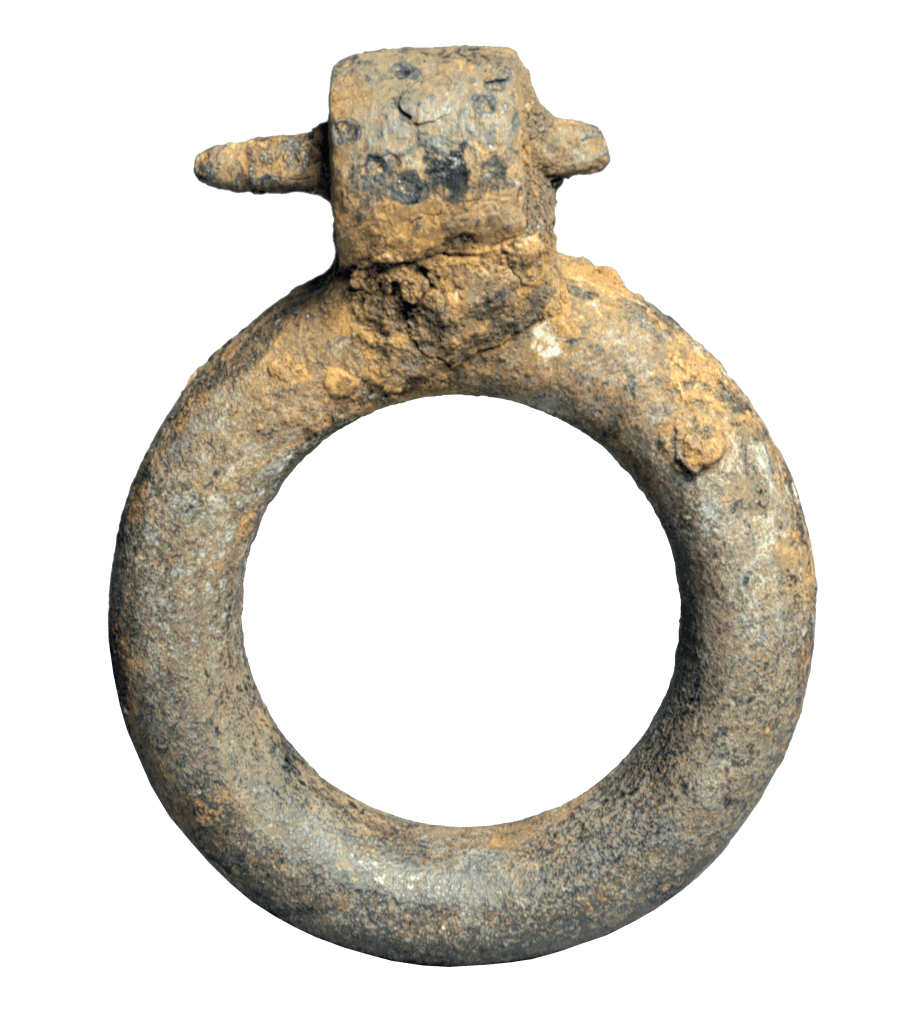
Enduring Ornament, 1913
Enduring Ornament
Elsa von Freytag-Loringhoven, 1913
Reed Enger, “Enduring Ornament,” in Obelisk Art History,
Published August 03, 2017; last modified October 14, 2022
The year is 1913 and Elsa Endell, kaleidoscopic performance artist and poet is on her way to New York’s city hall for her third marriage, this time to a German Baron named Leopold von Freytag-Loringhoven. En route, Elsa spots a rusted iron ring. To Elsa this street trash was a totem of her marriage to be, and in an act marking a new era in the definition of art—Elsa called this found object an artwork.
To state that artwork didn’t need to be created with your hands, but that found objects could be claimed as art through the force of the artist’s intent was a shockingly radical concept. And as so often happens with new ideas, the newly minted Elsa von Freytag-Loringhoven was not credited with the shattering of artistic tradition. A year later, Elsa’s close friend Marcel Duchamp showcased Bottle Rack, a found object he claimed as a new category of art, the ‘readymade.’
http://www.arthistoryproject.com/artists/elsa-von-freytag-loringhoven/enduring-ornament/.
Portrait of Duchamp (1919)
¶¶¶
“Les nouvelles fables de Fountain 1917-2017”
Michaël La Chance
En avril 1917, une pièce de céramique est déposée au Grand Central Palace, sur Lexington Avenue, afin d’être exposée au salon de la Société des artistes indépendants de New York. Cet urinoir est enregistré sous le nom de R. Mutt. Malgré les principes de base de la Société, dont l’absence de sélection, quelques membres du comité directeur contestent son statut d’œuvre et l’objet n’est pas exposé le soir du vernissage. On apprend plus tard que R. Mutt serait un pseudo dont le prénom est Richard, que l’œuvre est inti- tulée Fountain, que l’adresse du mystérieux R. Mutt est celle de Louise Norton, une femme de lettres qui dirige Rogue, une revue d’avant-garde. Malgré ce dernier indice, il ne fait pas de doute pour la plupart des gens que l’auteur de cette provocation est nul autre que Marcel Duchamp, l’enfant terrible de la scène de l’art. Pourtant, il faudra attendre plusieurs années avant que celui-ci revendique Fountain et se décide à en produire des copies, l’original ayant disparu quelques jours après le scandale.
En effet, au début des années cinquante, des galeristes se présenteront à la porte de Duchamp avec des urinoirs qu’ils lui demandent de signer. C’est que l’urinoir renversé de 1917, malgré sa disparition, ou plutôt parce qu’il a disparu, est l’une des œuvres les plus controversées du XXe siècle. Cent ans plus tard, il importe de revenir sur les « fables » de Fountain, sur la diversité des hypothèses et des scénarios qui entourent l’auteur (ou les auteur.e.s) de l’œuvre ainsi que sur les circonstances de sa création.
(…)
[Follow the link to read this important article — AC-P]
Ref.: La Chance, M. (2017). Les nouvelles fables de Fountain 1917-2017. Inter, (127), 1–74.
https://www.erudit.org/en/journals/inter/2017-n127-inter03190/86333ac/
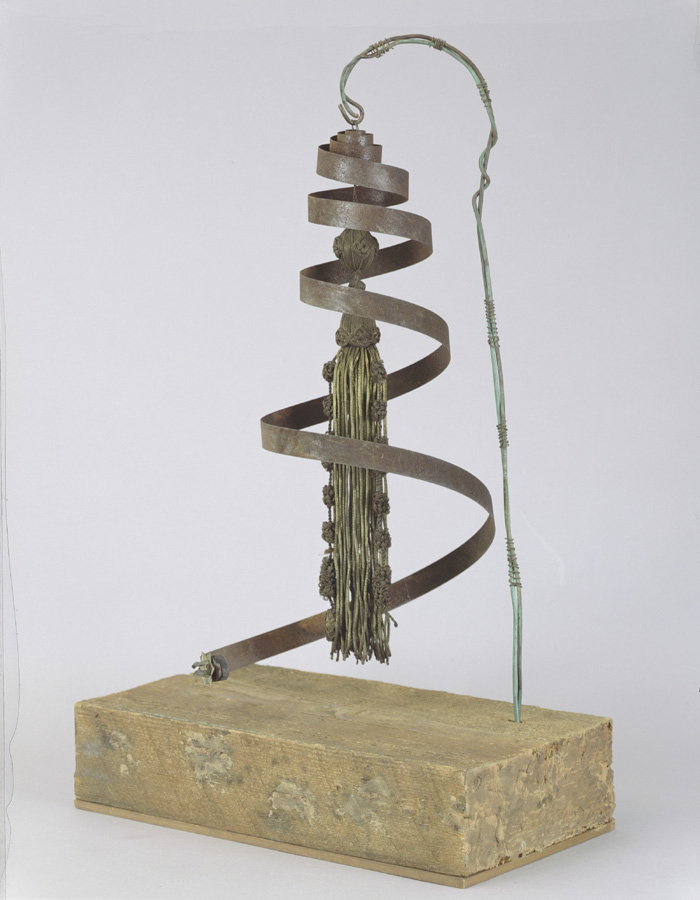
Limbswish. c. 1917-1918 Metal spring, curtain tassel, and wire mounted on wood block, Height with base: 21 11/16″ (55.1 cm); base approx. 14 x 7 1/2″ (35.6 x 19.1 cm) Mark Kelman, New York
(2018)
¶¶¶
“The urinal that precipitated modern art”
By Glyn Thompson
How a misattributed sanitary fixture kick-started an artistic movement.
December 5, 2018
Since the role played by plumbing in the history of modern art in America has largely escaped the attention of its critics, it would be no surprise it has also failed to fascinate its plumbers, who consequently might be intrigued to learn that the most influential work of art of the twentieth century was a urinal.
Sent under the pseudonym “R. Mutt” to an exhibition in New York on April 9, 1917 — and rejected because Mutt was not a member of the exhibiting society — this ‘submission’ would be misconstrued as demonstrating that art could be anything that an artist said it was, resulting in the colonization by “conceptual art” of galleries from Memphis, Egypt, to Memphis, Tennessee.
This allegedly radical gesture — one that overturned traditional art making — was then misattributed 18 years later to one Marcel Duchamp (1883-1968), but no evidence existed then or now to suggest or confirm that Duchamp had, in fact, been responsible.
In 1982, contemporary evidence from Duchamp’s own hand unexpectedly surfaced and disqualified him. This letter, sent to his sister in Paris, stated plainly that not he but a female friend had sent the urinal to exhibition.
But, secure in the delusion the letter that could expose him had apparently disappeared, in 1966 Duchamp would claim that he had obtained the urinal from the J. L. Mott Iron Works at Fifth Avenue and 17th Street in Manhattan — which would have been impossible, for the following reasons.
First, the Mott catalogue from April 1917 didn’t include the rejected urinal, photographed by Alfred Stieglitz in 1917, and from 1908 all J. L. Mott publicity reiterated that all the plumbing fixtures that it sold it manufactured itself — and this one it didn’t.
Second, vitreous porcelain urinals could be obtained from a manufacturer only by plumbing supply houses, which sold to contractors and master plumbers — not avant-garde artists.
Third, the seven floors of the J. L. Mott building at 118-120 Fifth Avenue (see Figure 2) that were accessible to the public consisted entirely of showrooms from which, as with automobiles, no direct retail purchases could be made, since their exclusive function then, as now, was to display — and many showroom fixtures were under pressure.
And, finally, the urinal in question had actually been made by the Trenton Potteries Company (TPCo) of Trenton, New Jersey, and manufactured in its particular size between 1915 and 1920, but in a smaller size range from 1892 to 1922. This was the Vitreous China Flat-back Lipped “Bedfordshire” No. 2 (See Figure 3) — by 1917, “Bedfordshire” urinals had for decades been made in three almost universally standard sizes.
As the master plumbers of America will be aware, the “Bedfordshire” was the most basic, simplest and cheapest of wall-hung earthenware urinals, the first examples made on and of American soil — copies of English imports — being manufactured by Thomas Maddock in Trenton in 1873 (see Figure 4).
There was, in fact, a “Bedfordshire” model in the Mott inventory (of seven urinals) in 1917 (see Figure 5), but it cannot be confused with the TPCo example since the two clearly differed in critical details.
First, the unique combination and style of perforated ventilator and integral strainer of the Trenton Potteries’ “Bedfordshire” cannot be mistaken for that of the Mott, nor of any other design or make of urinal. And second, the Mott model incorporated a patent overflow that the Trenton Potteries model clearly lacked.
While the system whereby urinals were manufactured, marketed and distributed in the U.S. in the period running up to and beyond World War 1 invalidated Duchamp’s claim, it simultaneously made it easy for his female friend to stroll into any of the scores of high-street plumbers’ shops in Philadelphia — where she resided and from where the rejected urinal would be sent to New York — and pick up a urinal cheaply, for the article in question had suffered a fault in its burning that rendered it useless to a plumber.
This is revealed if an actual example of the urinal (see Figure 7) is compared with another photograph taken of the same article in the summer of 1918, showing it hanging from the ceiling of Duchamp’s studio.
But the fault can only be identified by those who know what they’re looking at, which means that to unravel this conundrum you need to consult Joe the Plumber, who can tell you that the fault had occurred at the dynamic fulcrum of the pattern where the perforated ventilator and the integral strainer meet at the seam joining the back of the urinal to the bowl — rather than a Duchamp ‘expert,’ who can’t.
Mutt’s urinal’s actual author was not exactly a “nobody,” though. On the run from the NYPD for shoplifting, cross-dressing quick-change artist Baroness Elsa Von Freytag-Loringhoven had fled to Philadelphia from New York in January 1917. Astonishingly, the daughter-in-law of the German Kaiser’s Chief of Staff lived precariously on the fringes of the art world, scratching a living as a model, shoplifter and possibly prostitute.
But because she was a woman, she would be written out of the boys’ club of modern art. And since she died in 1927 in relative obscurity (see Figure 8), she wasn’t around in 1935 when her urinal was misattributed by Andre Breton to Duchamp.
Breton failed to cite any evidence in support of his claim. No surprise there, because none exists.
https://www.pmmag.com/articles/101751-the-urinal-that-precipitated-modern-art
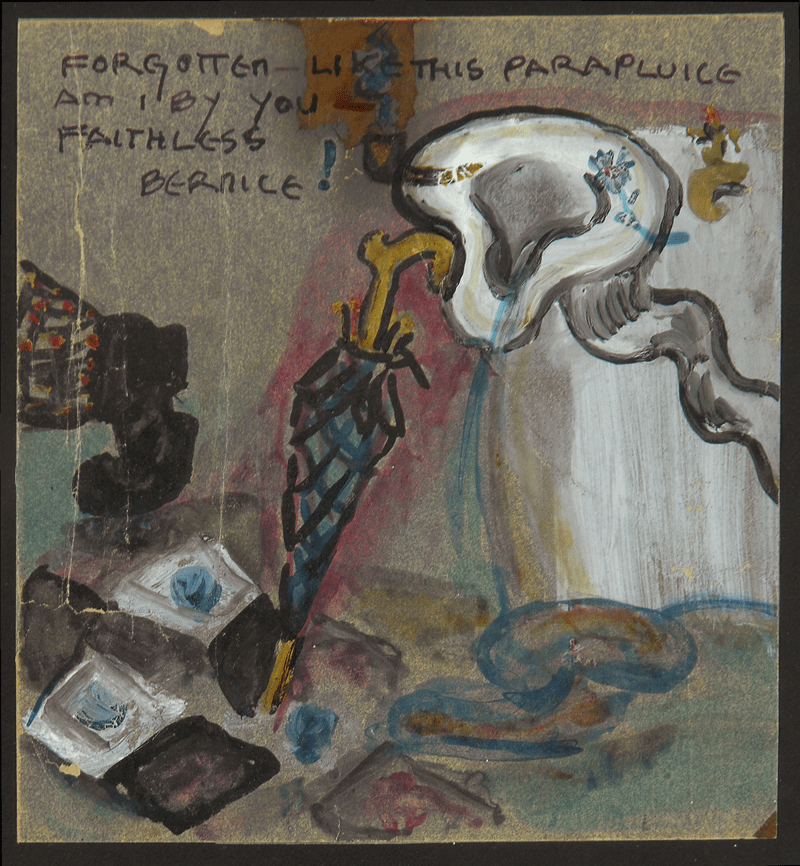
Forgotten—like this parapluice am I by you—faithless Bernice! (1923-1924)
gouache on paper, 13 x 12 cm
© Private Collection
¶¶¶
“The iconic Fountain (1917) is not created by Marcel Duchamp”
Door Theo Paijmans | june, 2018
In 1917, when the United States was about to enter the First World War and women in the United Kingdom had just earned their right to vote, a different matter occupied the sentiments of the small, modernist art scene in New York. It had organised an exhibit where anyone could show his or her art against a small fee, but someone had sent in a urinal for display. This was against even the most avant-garde taste of the organisers of the exhibit. The urinal, sent in anonymously, without title and only signed with the enigmatic ‘R. Mutt’, quickly vanished from view. Only one photo of the urinal remains.
BUT THEN THINGS TOOK A TURN
In 1982 a letter written by Duchamp came to light. Dated 11 April 1917, it was written just a few days after that fateful exhibit. It contains one sentence that should have sent shockwaves through the world of modern art: it reveals the true creator behind Fountain – but it was not Duchamp. Instead he wrote that a female friend using a male alias had sent it in for the New York exhibition. Suddenly a few other things began to make sense. Over time Duchamp had told two different stories of how he had created Fountain, but both turned out to be untrue. An art historian who knew Duchamp admitted that he had never asked him about Fountain, he had published a standard-work on Fountain nevertheless. The place from where Fountain was sent raised more questions. That place was Philadelphia, but Duchamp had been living in New York.
FEMALE FRIEND
Who was living in Philadelphia? Who was this ‘female friend’ that had sent the urinal using a pseudonym that Duchamp mentions? That woman was, as Duchamp wrote, the future. Art history knows her as Elsa von Freytag-Loringhoven. She was a brilliant pioneering New York dada artist, and Duchamp knew her well. This glaring truth has been known for some time in the art world, but each time it has to be acknowledged, it is met with indifference and silence.
This article addresses the true authorship of Fountain from the perspective of the latest evidence, collected by several experts. The opinions they voice offer their latest insights. Their accumulation of evidence strengthens the case to its final conclusion. To attribute Fountain to a woman and not a man has obvious, far-reaching consequences: the history of modern art has to be rewritten. Modern art did not start with a patriarch, but with a matriarch. What power structure in the world of modern art prohibits this truth to become more widely known and generally accepted? Ultimately this is one of the larger questions looming behind the authorship of Fountain. It sheds light on the place and role of the female artist in the world of modern art.
FORGOTTEN AND IGNORED
Why did Elsa von Freytag-Loringhoven never claim Fountain as her work? She never had the chance. While she lived the urinal was thrown out, became lost and quickly forgotten. She died in 1927, eight years before Bréton attributed Fountain to Duchamp for the first time. Decades after her death Duchamp began to commission the first replica of Fountain. While he rose to superstardom, she ended as a footnote in the history of modern art. Her artist career is exemplary for what has happened to countless other female artists who were ignored, marginalized and ostracized from the canon.
In this larger frame, the true story about who really created Fountain’s is one poignant example out of many. It is time for art history to be rewritten – and that time is now.
‘ONE OF MY GIRLFRIENDS’
When Andre Bréton attributes the work to Duchamp in 1935, he remains silent. In the 1960s, Duchamp puts stories into the world that are supposed to confirm that it was his work – stories that are easy to unmask, as it turns out. In the 1980s, a letter from Marcel Duchamp from 1917, in the same month that the exhibition took place, surfaces. In this letter he writes to his sister Suzanne that one of his girlfriends has submitted a urinal for the exhibition. However, this letter does little for the recognition of the real maker. Duchamp has already become the father of conceptual art. He is too big to fail , thanks to ‘his’ masterpiece Fountain in 1917. There are exactly seventeen replicas of Fountainin circulation – in the collections of, among others, Tate Modern in London, The Philadelphia Museum of Art, San Francisco Museum of Modern Art and The National Museum of Modern Art, Kyoto – all commissioned by Duchamp. None of the replicas mention the name of the real maker: Elsa von Freytag-Loringhoven.
FINALLY
The debate is not over yet. There are pros and cons. But, leaving Fountain‘s authorship aside, it is remarkable that so many people have been able to become acquainted with the genius artist Elsa von Freytag-Loringhoven. As Joyce Roodnat described so beautifully in the NRC last week:
I’m following the debate on the issue. I notice how holy Duchamp is and I think: don’t worry so much. Fountain exists, that’s the main thing. What touches me more is that I only now know about the influential German artist who shook up the New York avant-garde between 1913 and 1923, using her body as an instrument and her life as a work of art in progress. I buy her biography (by Irene Gammel, 2003) and enjoy myself blankly. What a wonderful woman. Pure dada. How is it possible that she is so little known? Why all those exhibitions about Marcel Duchamp and not about her?
Long live Elsa! And all those other great artists that we will discover.
(2019)
¶¶¶
“A woman in the men’s room: when will the art world recognise the real artist behind Duchamp’s Fountain?”
Siri Hustvedt
The Guardian, Fri 29 Mar 2019 13.00 GMT
Last modified on Wed 3 Apr 2019 15.11 BST
Evidence suggests the famous urinal Fountain, attributed to Marcel Duchamp, was actually created by Baroness Elsa von Freytag-Loringhoven. Why haven’t we heard of her, asks Siri Hustvedt
The story goes like this: Marcel Duchamp, brilliant inventor of the “ready-made” and “anti-retinal art”, submitted Fountain, a urinal signed R Mutt, to the American Society of Independent Artists in 1917. The piece was rejected. Duchamp, a member of the board, resigned. Alfred Stieglitz photographed it. The thing vanished, but conceptual art was born. In 2004 it was voted the most influential modern artwork of all time.
But what if the person behind the urinal was not Duchamp, but the German-born poet and artist Baroness Elsa von Freytag-Loringhoven (1874-1927)? She appears in my most recent novel, Memories of the Future, as an insurrectionist inspiration for my narrator. One reviewer of the novel described the baroness as “a marginal figure in art history who was a raucous ‘proto-punk’ poet from whom Duchamp allegedly stole the concept for his urinal”. It is true that she was part of the Dada movement, published in the Little Review with Ezra Pound, Djuna Barnes, TS Eliot, Mina Loy and James Joyce and has been marginalised in art history, but the case made in my book, derived from scholarly sources enumerated in the acknowledgements, is not that Duchamp “allegedly stole the concept for his urinal” from Von Freytag-Loringhoven, but rather that she was the one who found the object, inscribed it with the name R Mutt, and that this “seminal” artwork rightly belongs to her.
In the novel, I quote a 1917 letter Duchamp wrote to his sister, Susanne. I took the translation directly from Irene Gammel’s excellent biography of Von Freytag-Loringhoven, Baroness Elsa: “One of my female friends who had adopted the masculine pseudonym Richard Mutt sent me a porcelain urinal as a sculpture.” I got it wrong. Glyn Thompson, an art scholar and indefatigable champion of the baroness as the brain behind the urinal, pointed out to me that Duchamp wrote “avait envoyé” not “m’a envoyé” – “sent in”, not “sent me”. R Mutt was identified as an artist living in Philadelphia, which is where she was living at the time. In 1935 André Breton attributed the urinal to Duchamp, but it wasn’t until 1950, long after the baroness had died and four years after Stieglitz’s death, that Duchamp began to take credit for the piece and authorise replicas.
Duchamp said he had purchased the urinal from JL Mott Ironworks Company, adapting Mutt from Mott, but the company did not manufacture the model in the photograph, so his story cannot be true. Von Freytag-Loringhoven loved dogs. She paraded her mutts on the sidewalks of Greenwich Village. She collected pipes and spouts and drains. She relished scatological jokes and made frequent references to plumbing in her poems: “Iron – my soul – cast iron!” “Marcel Dushit”. She poked fun at William Carlos Williams by calling him WC. She created God, a plumbing trap as artwork, once attributed to Morton Schamberg, now to both of them. Gammel notes in her book that R Mutt sounds like Armut, the word for poverty in German, and when the name is reversed it reads Mutter – mother. The baroness’s devout mother died of uterine cancer. She was convinced her mother died because her tyrannical father failed to treat his venereal disease. (The uterine character of the upside-down urinal has long been noted.) And the handwriting on the urinal matches the handwriting Von Freytag-Loringhoven used for her poems.
All this and more appears in Gammel’s biography. All this and more reappears in my novel. All the evidence has been painstakingly reiterated in numerous articles and, as part of the Edinburgh festival fringe, Glyn Thompson and Julian Spalding, a former director of Glasgow Museums, mounted the 2015 exhibition A Lady’s Not a Gent’s, which presented the factual and circumstantial evidence for reattribution of the urinal to Von Freytag-Loringhoven.
https://www.theguardian.com/books/2019/mar/29/marcel-duchamp-fountain-women-art-history

‘—on n’a que: pour femelle la pissotière et on en vit’
(‘for female there is only the pissoir and one lives by it)
—in La Boîte de 1914 (?)
¶¶¶
Atlas Press
“Marcel Duchamp was not a thief”
This is the first of three pages on this site devoted to the accusation by Professor Irene Gammel, and then by Julian Spalding and Glyn Thompson, that the Baroness Elsa von Freytag-Loringhoven was involved in the creation of “Fountain” by Marcel Duchamp — indeed, according to Spalding and Thompson, that he actually stole it from her.
Following letters from Dawn Ades in The Guardian and from Alastair Brotchie in The Times Literary Supplement, objecting to repetitions of this unproved allegation, we decided to join forces to refute it factually. By chance, it was around this time that we discovered that Bradley Bailey had found important new information that he was about to publish in The Burlington Magazine (161, October 2019). The same issue therefore included our detailed summary of the factual evidence to date (and this version of it has been updated to include Bailey’s discoveries) and it was hoped that this text would launch a debate between all protagonists based around facts rather than suppositions.
This summary remains the most detailed survey of the facts, along with critiques of the alternative accounts based on these facts.
Here are the complete contents of the pages that follow:
PAGE 1: MARCEL DUCHAMP WAS NOT A THIEF https://atlaspress.co.uk/marcel-duchamp-was-not-a-thief/
Texts 1. Dawn Ades and Alastair Brotchie, “Marcel Duchamp Was Not a Thief”, The Burlington Magazine, December 2019, (an overall summary of the controversy, below).
PAGE 2: MARCEL DUCHAMP AND THE BARONESS https://atlaspress.co.uk/marcel-duchamp-and-the-baroness/
Texts 3. Letters to The Art Newspaper, 320, February, 2020.
3a. Dawn Ades and Alastair Brotchie, “Did Duchamp really steal Elsa’s urinal?”
3b. Julian Spalding, “It’s the world’s first great feminist, anti-war artwork”.
3c. Glyn Thompson, “No grounds for Ades’s view”.
3d. Dawn Ades and Alastair Brotchie. Replies to 3b and 3c.
Texts 4. Letter to The Art Newspaper, 322, April 2020. Dawn Ades and Alastair Brotchie, “Urinal row rages on”.
PAGE 3: DUCHAMP AND THE BARONESS: END OF THE FOUNTAIN AFFAIR
Texts 2: Emails from Dawn Ades and Alastair Brotchie to Irene Gammel.
2a. Email of 26/11/19.
2b. Email to 9/12/19.
2c. Letter of 6/1/20.
2d. Email of 23/1/20.
Texts 5. Irene Gammel. “Last word on the art historical mystery of R. Mutt’s Fountain?”, The Art Newspaper, 326, September 2020.
Texts 6. Letter to The Art Newspaper, 326, September 2020, and expanded response.
6a. Dawn Ades and Alastair Brotchie. “The last word? Not likely…”
6b. Dawn Ades and Alastair Brotchie. More detailed response to Irene Gammel (Text 5)
Texts 7. Irene Gammel. “Plumbing fixtures: The vexing and perplexing case of R. Mutt’s ‘Fountain’” in The Burlington Magazine, January 2021.
Texts 8. Letter to The Burlington Magazine, January 2021, and expanded response.
8a. Dawn Ades and Alastair Brotchie. “The Authorship of ‘Fountain’”, (reply to 7).
8b. Dawn Ades and Alastair Brotchie. More detailed response to Irene Gammel (Text 7).
Texts 9. Letters to The Burlington Magazine, April 2021, and expanded response.
9a. Julian Spalding. “‘Fountain’, Marcel Duchamp and Elsa von Freytag-Loringhoven” (reply to Gammel, text7).
9b. Glyn Thompson. “‘Fountain’, Marcel Duchamp and Elsa von Freytag-Loringhoven” (reply to Gammel, text 7).
9c. Dawn Ades and Alastair Brotchie. “End of the Fountain controversy”, reply to Spalding & Thompson, 9a and 9b.)
9d. Dawn Ades and Alastair Brotchie. More detailed response to 9a and 9b.
We leave it to readers to decide if Gammel and Spalding and Thompson have answered our challenge to their different allegations.
Text 1: The Burlington Magazine, December 2019 (with subsequent small modifications)
“Marcel Duchamp Was Not a Thief”
by DAWN ADES and ALASTAIR BROTCHIE
Notes are at the end. This article is being updated (our thanks for corrections from Francis Naumann) in order to make it the definitive account of this affair. The reader will see, as the correspondence unfolds, that neither Irene Gammel, Julian Spalding and Glyn Thompson, nor David Lee, editor of The Jackdaw (who expressed his agreement with Spalding and Thompson when he published them), have responded to any of the specific points in this account that dispute their versions.
In November 2014 The Art Newspaper published an article by Julian Spalding and Glyn Thompson, ‘Did Marcel Duchamp steal Elsa’s urinal?’1 Their contention, and that of Irene Gammel, the biographer of the artist and poet Baroness Elsa von Freytag-Loringhoven, is that the Baroness was responsible for submitting the famous Fountain, an upturned urinal signed ‘R. Mutt’, to the Society of Independent Artists (SIA) exhibition in New York in April 1917.
The idea of Duchamp as an ‘art-thief’ has become something of an internet meme – accepted as true, without anyone ever bothering to check the evidence. Refuting it then becomes a matter of proving a negative, which is much harder to do. We are well aware that facts and evidence can be rather less amusing than speculation and conspiracy theories, but there is a truth to be revealed here that relates to the integrity of one of the most important artists of the last century, and an artwork frequently judged the most important of the last 100 years. This truth has been carefully obscured by a blizzard of irrelevant research by Spalding and Thompson, the intention of which appears to have been to conceal the fact that no serious evidence whatsoever has been presented that links the Baroness to Fountain. Moreover, Bradley Bailey’s article in The Burlington Magazine published evidence that finally put paid to their speculative contentions. These contentions nonetheless need to be dealt with, and following Bailey’s article we wanted to summarise the facts of this affair.
There are three versions of the events that gave rise to this ‘sculpture’: firstly, the generally accepted account, based on what Duchamp himself said, and accounts by eye-witnesses, the perpetrators and contemporary publications; secondly, Gammel’s speculations in her biography of the Baroness; and thirdly, Spalding’s and Thompson’s account, which attempts to claim Fountain for the Baroness while avoiding the inaccuracies in Gammel’s version.
According to Duchamp’s biographer,2 the idea for the urinal was due to a last-minute impulse. Following a lunch together, and just before the SIA exhibition was about to open, Duchamp, accompanied by Walter Arensberg and Joseph Stella, bought a urinal at a store, and he either took it to his studio or directly to the exhibition venue, signed it ‘R. Mutt’ and attached a submission label bearing the address of Louise Norton. It was then submitted for exhibition, but never was exhibited. Instead it was taken to Alfred Stieglitz’s studio so he could photograph it.3 Duchamp used the inevitable scandal (which would have occurred whether the exhibit was accepted or not) and Stieglitz’s photograph to explain the rationale behind readymades in the magazine The Blindman, again anonymously, through an article by his friend Beatrice Wood.4 Thus two of Duchamp’s female friends collaborated in this affair: Norton and Wood.
Gammel’s version is that the Baroness may have sent the urinal to Duchamp, who put it in for the exhibition. He then used the scandal to explain readymades. She casts doubt on Duchamp’s authorship of Fountain on the basis of a letter from Duchamp to his sister Suzanne, dated 11th April 1917. The relevant part of Duchamp’s letter reads:
Tell the family this snippet: the Independents opened here with enormous success. A female friend of mine, using a male pseudonym, Richard Mutt, submitted a porcelain urinal as a sculpture. It wasn’t at all indecent. No reason to refuse it. The committee decided to refuse to exhibit this thing. I handed in my resignation and it’ll be a juicy piece of gossip in New York.5
Gammel translated this letter so that the pivotal sentence reads: ‘One of my female friends who had adopted the pseudonym Richard Mutt sent me a porcelain urinal as a sculpture’.6 Gammel then tentatively identified the ‘female friend’ as the Baroness, based solely on the fact that, according to a journalist, Mutt lived in Philadelphia (see note 23 for the text), as did the Baroness. Gammel suggests that the Baroness may have sent the urinal to Duchamp, and that it therefore might have been ‘a collaboration’.7
Gammel’s interpretation is mistaken. The letter actually says that Fountain was submitted to the SIA in the category of sculpture, and not sent to Duchamp personally. No one knows why the journalist gave the artist’s home as Philadelphia,8 and his article is unreliable as a source, because even though it is very short it contains several other blatant errors or inventions.9 There is, furthermore, a version of Alfred Stieglitz’s photograph of Fountain (Fig.2) in which the submission label is visible and the artist’s address is clearly legible. The address is not that of the Baroness but of Louise Norton. Gammel relegated this important information to an endnote.10 The writing on the label is not Louise’s,11 but Duchamp could have asked anyone to fill it in using Norton’s address, or could have done it himself and disguised his handwriting.12 Finally, Norton’s involvement was further confirmed when it was discovered that the phone number for contacting Mutt given to the critic Henry McBride by Charles Demuth, was hers.13 Gammel does not mention this fact at all.
While Spalding and Thompson acknowledge that their version is based upon Gammel’s research,14 they need a different story in order to avoid its shortcomings, namely her ignoring the evident part played by Norton, and her incorrect translation of the letter. So they speculate that the Baroness (then famously close to destitution) buys the urinal in Philadelphia, presumably signs it (while disguising her handwriting, even though her handwriting would be unknown to anyone involved), and then has it sent to Norton, who adds the label and submits it. Duchamp then ‘steals’ it and uses it to explain readymades. Thus the whole of their case depends on the Baroness and Norton knowing each other, and they baldly state that Norton ‘knew Elsa well’.15 No source is given for this statement, and Bailey has revealed in his article that, according to Norton’s own words, she did not know the Baroness. The Spalding and Thompson version cannot, therefore, be correct.
Spalding’s and Thompson’s evidence for their version is the letter to Suzanne; the Philadelphia connection; and the assertion that Duchamp’s account of how he bought the urinal is incorrect (based on Thompson’s research intended to prove that the firm of Mott did not make this model of urinal, etc.).
The evidence against it is as follows: Spalding and Thompson repeatedly use the letter as evidence that Duchamp ‘lied’ about the origins of Fountain. In fact, Duchamp told his sister exactly what friends in the New York art scene who were not in on the hoax were allowed to know. Stieglitz repeated precisely the same story in a letter to Georgia O’Keefe, and the previously mentioned letter from Demuth to MacBride does essentially the same.16 Spalding and Thompson criticise Duchamp’s biographer’s interpretation of the letter to Suzanne:17 ‘Tomkins [. . .] argues that Duchamp wanted (for reasons he doesn’t explain) to keep his involvement in the “affair” of the urinal secret. This was why he pretended in his letter to his sister that a “female friend” had submitted the object. But this explanation makes no sense because his sister, a Red Cross nurse in Paris, had no contacts with the New York media’.18
However, Tomkins is correct and Spalding and Thompson are wrong. There is no mystery as to why Duchamp needed to keep his identity secret. He was on the board of directors of the SIA exhibition and head of the hanging committee, and if he had submitted the urinal under his own name then some way would have been found to defuse the situation, and avoid the scandal he was intent upon, as he explained in an interview in 1966.19 As for the assertion that the artist (rather than ‘the nurse’) Suzanne Duchamp was not in touch with the New York art scene (rather more important than the “media” in this context), her partner in Paris was Jean Crotti, soon to be her husband, who in 1916 had shared a studio with Duchamp in New York. Crotti had lived there for several years, and had been a habitué of the Arensberg salon. He was on amiable terms with many of those involved with the exhibition, as well as with members of the wider international avant-garde.
Spalding and Thompson have disputed Duchamp’s reason for secrecy, but not explained the Baroness’s.20 Why would she have gone to all this trouble to submit this ‘sculpture’ under an assumed name? (Suggestions please?) Spalding and Thompson also speculate that R. Mutt should be read as ‘armut’, the German for poverty, or “urmutter”,21 earth mother, and that this explains the work’s meaning when attributed to the Baroness: it was ‘Elsa’s declaration of war against a man’s war – an extraordinary visual assault on all that men stood for’.22 This is an amusing game, and we can all come up with possible meanings for artworks, but to be taken seriously they need to be based on something, perhaps a convincing similarity to the author’s other works or on documentary evidence. This is absent here, and it seems especially unlikely because for nearly everything else that the Baroness wrote or made in the USA, she used English (for obvious reasons).
There are a number of other objections to this scenario. According to the label, “Richard Mutt” (not R. Mutt) submitted an exhibit called ‘Fountain’, and not ‘Urinal’ as Spalding and Thompson suppose (note 11). Had it been exhibited, visitors would have assumed that ‘R. Mutt’ was the artist’s signature (because it was), and nothing would have indicated that the key to the work’s meaning was not to be found in its title, which would be the usual practice, but in the artist’s name. Even that knowledge would have been insufficent: the viewer had to know that it must be read as a German homonym. However, no clues were given (Mutt is not even a German name), so this supposed meaning of the work would have been completely opaque to viewers at the exhibition: a rather ineffective ‘declaration of war’! Furthermore, this supposedly “feminist” artwork, “an assault on all that men stood for”, was submitted under a man’s name, which further muddies the waters, and the work would, presumably, have had its actual title of Fountain, since this is visible on the submission label — a title that appears to us unrelated to the intentions invented for it by Spalding and Thompson. Absurdity upon absurdity, and none of it adds up.
The extreme unreliability of the original journalist’s reference to Philadelphia has already been pointed out, even by Spalding and Thompson,23 yet (so far as we can see) their identification of the Baroness as the ‘female friend’ is based solely on this source, which furthermore refers to “Mutt” and not to the Baroness. Thompson devotes interminable pages to proving that the firm of Mott did not make this model of urinal, and so on. This is all irrelevant if no connection between Fountain and the Baroness can be made, but it is still worth noting that Thompson’s arguments are almost entirely based upon a Mott catalogue dated 1908,24 and so cannot prove anything about events that happened in 1917.
Finally, Spalding and Thompson repeatedly allude to the fact that neither Norton nor the Baroness were members of the SIA and therefore they were not eligible to submit anything, let alone after the submission deadline.25 These strictures did not apply to Duchamp, who was actually supervising the hanging of the exhibition. But we do not understand why Spalding and Thompson think this information supports, rather than refutes, their case?
Such was the state of this debate until recently. No connection had been established between Fountain and the Baroness. On the contrary, many facts suggested that it was extremely unlikely that she had anything to do with it, not the least of them being that she herself never claimed the work as her own, at the time, nor in the years afterwards, in private or in print. She did not even object to the second issue of The Blindman, which was dedicated to Fountain, to which she was not invited to contribute and which, of course, does not mention her name. Why such extraordinary restraint? Likewise, none of the many people involved ever mentioned her name in connection with this affair at the time, nor in any of their subsequent interviews or numerous memoirs.26
In his genuinely brilliant research published in The Burlington Magazine, Bailey has revealed two crucial facts which confirm the generally accepted version of events. First, the Baroness could not have sent Fountain to Louise Norton: Bailey cites an unpublished interview of March 1978 with Norton and Beatrice Wood in which both say that they neither met nor knew of the Baroness at the time, although subsequently they vaguely heard of her.27 Their exact words were as follows:
BW: Who was that creature that I was told Marcel liked [. . .] the Baroness or something? Did you know about her?
LN: I don’t know.
BW: I never met her. She is supposed to be very eccentric and dressed in a very strange way.
LN: I never met her, no.
BW: You remember hearing about her?
LN: Vaguely, you see, it rings a bell that’s never rung before.
Thus the Baroness cannot have been the ‘female friend’ of Duchamp’s letter; it can only have been Norton, just as common sense indicated all along.28
Secondly, Norton, in the unpublished draft of an article written in 1972 that discussed the SIA exhibition, wrote of Duchamp that:
Marcel was more serious in one of his jests than I realised at the time. Co-Founder and member of the Sty. of Independent Artists he helped organise the Independents Show of 1917. There was to be no jury. Any painter’s work would be exhibited on payment of a six dollar fee. To test the bona fides of the hanging committee he sent in a porcelain urinal which he titled, Fountain by R. Mutt. The committee promptly threw it out and Marcel very angry promptly resigned.
With this statement, ‘the female friend’, Louise Norton, confirmed Duchamp’s authorship of this work of art. Furthermore, she states that Duchamp himself ‘sent in’ the urinal, which confirmed Duchamp’s version: there was never any need for it to go to Norton’s house, and only in Spalding’s and Thompson’s version of events does Norton herself send it from there.
This statement of Louise Norton’s needs putting in context. Almost the only undisputed fact in this affair is that Norton’s address was on the submission label attached to Fountain: this fact is agreed by Gammel, by Spalding and Thompson and by those who accept Duchamp’s account. Gammel consigned it to a footnote, Spalding and Thompson acknowledge it and assert that Norton submitted the urinal for the Baroness, in the accepted account it was either Duchamp or Norton who ‘submitted’ the urinal, but it seems from what she says here that she simply allowed Duchamp to use her address. Whatever the case, Louise Norton is the only person whose pivotal role is acknowledged in all three versions of these events, and because of this role she had to know what actually happened. And she wrote that Duchamp ‘sent in a porcelain urinal which he titled, Fountain by R. Mutt’. A statement of total clarity, which on its own refutes the versions proposed by Gammel, Spalding and Thompson. It is a great shame this statement was not published when Gammel wrote her biography of the Baroness, because then this whole controversy could never have arisen.
Despite Gammel’s welcome aim of restoring agency to women artists and poets, it is unfortunate that she chose to champion the Baroness rather than the other women in the New York avant-garde who were actually involved in the 1917 Fountain incident, and who are no less forgotten by history: Louise Norton and Beatrice Wood. Contrary to Gammel’s approach, Spalding and Thompson have been belligerently abusive from the start. So we repeat what we wrote at the beginning of this letter: there is no evidence of Elsa von Freytag-Loringhoven being involved in any way whatsoever with Fountain. Unless they can provide evidence on this specific point, we suggest that the honourable course of action on their part would be to admit they were mistaken and to apologise for their accusations, which have turned out to be unfounded.
NOTES
1 J. Spalding and G. Thompson: ‘Did Marcel Duchamp steal Elsa’s urinal?’, The Art Newspaper, 3rd November 2014, available at http://ec2-79-125-124-178.eu-west-1.compute.amazonaws.com/articles/Did-Marcel-Duchamp-steal-Elsas-urinal/36155, accessed 12th November 2019. (We note the casual sexism of the title, with the male artist formally referred to by surname and the female more familiarly by her first name.)
2 C. Tomkins: Marcel Duchamp, A Biography, London 1997, p.181. See also A. Schwarz: The Complete Works of Marcel Duchamp, London 1969, p.466; W. Camfield: Fountain, Houston 1989, p.21; S. Haworth: ‘Fountain: summary’ (2009), rev. J. Mundy (2015), Tate, www. tate.org.uk/art/artworks/duchampfountain-t07573, accessed 12th November 2019; and G. Thompson: ‘Recognise this?’, The Jackdaw 125 (January/February 2016), p.12.
3 See S. Greenhough, ed.: My Faraway One: Selected Letters of Georgia O’Keeffe and Alfred Stieglitz, I (1915– 1933), New Haven and London 2011.
4 Wood claims in her autobiography that she wrote it (I Shock Myself, San Francisco 1985, p.31), and there is no reason to disbelieve her, but in an interview Duchamp later remembered it as a joint effort between her, himself and H.-P. Roché (S. Stauffer: ‘Marcel Duchamp’, Die Schriften, 1, 1981, p.280). These two versions can be easily reconciled if the article was the result of conversations between these three that were summarised by Wood, as implied by the entry in her diary for 7 April 1917: “Discussion about Richard Mutt’s exhibit[ion]. Read Roche my articles. We work at Marcel’s” (Archives of American Art, Beatrice Wood Papers). The editorial does not specifically use the word “readymade” but does explain Duchamp’s ideas behind this concept. The connection between the urinal and readymades was first specifically made by Picabia in 391, VIII (February 1919), p.8, although Spalding and Thompson repeatedly assert that this connection was first made by André Breton in 1935 (e.g. at http://www.openculture.com).
5 F. Naumann and H. Obalk, eds: Affectionately Marcel, The Selected Correspondence of Marcel Duchamp, transl. J. Taylor, London 2000, p.47.
6 I. Gammel: Baroness Elsa, Gender, Dada and Everyday Modernity, Cambridge MA and London 2002, p.224. Gammel incorrectly states that Fountain was displayed at the SIA exhibition, and makes various other conjectures that are rebutted in D. Ades: ‘Marcel Duchamp’s “Fountain”: a continuing controversy’, Journal of the London Institute of ’Pataphysics 14/15 (2018), pp.109–11.
7 Gammel, op. cit. (note 6), p.225. However, Spalding and Thompson consistently exaggerate Gammel’s position, and in their correspondence with Nicholas Serota they write that she had concluded that the evidence that Fountain should be attributed to the Baroness was ‘overwhelming’, Thompson, op. cit. (note 2), p.4. She neither wrote this nor implied it.
8 It is likely that he or his informant was being ironic, in the manner of W.C. Fields. Philadelphia, due to its Mormon and Quaker roots, was considered to be notoriously dull, and thus the last place one would expect to find anything ‘avant-garde’. Within the Arensberg circle, Boston and Pennsylvania were thought of as opposites (see Mina Loy’s compilation of overheard conversation there in The Blindman 2, p.15, and see note 16 below). Even according to Harper’s Magazine, at that time, ‘The one thing unforgivable in Philadelphia is to be new, to be different from what has been’ (quoted in R.F. Weighley et al.: Philadelphia: A 300-Year History, New York and London 1983, p.535, cited in https://en.wikipedia.org/ wiki/History_of_Philadelphia, accessed 12th November 2019).
9 Cited in J. Spalding and G. Thompson: ‘Who did it? Not Duchamp!’, The Jackdaw (hereafter Jackdaw 2015), 4th September 2015, http://www.thejackdaw.co.uk/ wp-content/uploads/2015/09/DuchampFountain-II1.pdf, p.22. See also note 22.
10 Gammel, op.cit. (note 6), p.446, note 53.
11 Jackdaw 2015, p.6. Concerning this label, Spalding and Thompson, who assert that the true title of this work by the Baroness should be ‘Urinal’ (op.cit. p.16), repeatedly state (op.cit. pps.6, 7, 23 and elsewhere) that it does not bear the title Fountain, and that this title was only given to the sculpture afterwards by Duchamp or Stieglitz. This is vital to Spalding and Thompson’s account, due to the importance given, in the editorial by Barbara Wood in The Blindman 2, to the act of re-naming the object, so as to give it a new conceptual context. Thus if the object was not re-named, it could not be by Duchamp. Recent scans of the photograph, however, allow one to read the last 5 letters of the word “Fountain” on the first line of the label (for example in Stefan Banz: Marcel Duchamp: Richard Mutt’s Fountain, Les Presses du Réel, 2019, p.43).
12 He was eminently capable of this, as shown by his work Cheque Tzanck (1919; Israel Museum, Jerusalem).
13 Camfield, op.cit. (note 2), p.30, and Jackdaw 2015, p.6.
14 Jackdaw 2015, p.17.
15 Spalding and Thompson, op. cit. (note 1), an assertion repeated in Jackdaw 2015, p.11.
16 In Jackdaw 2015, p.7, Spalding and Thompson assume (without giving any evidence) that it was Duchamp who told Stieglitz this story, which would in fact strengthen the case that this was what he told everyone not directly involved, including his sister. Alternatively, Stieglitz might have been “in” on the affair and so was simply repeating the “story” to O’Keefe. It is also interesting that the article by McBride, following the letter from Demuth, mentions the Philadelphia connection. Demuth, a lifelong Pennsylvanian, was therefore involved with press relations on this matter and so may be the original source of this witticism.
17 Tomkins, op. cit. (note 2), p.181.
18 [editorial]: ‘How Duchamp stole the urinal’, Scottish Review of Books, 4th November 2014, available at https:// http://www.scottishreviewofbooks. org/2014/11/how-duchamp-stole-theurinal/, accessed 12th November 2019. This is a longer version of Spalding and Thompson, op. cit. (note 1).
19 See Camfield, op. cit. (note 2), p.22.
20 Jackdaw 2015, p.11. So far as we are aware. In Spalding and Thompson’s version of events, it was the Baroness, in Philadelphia, who signed this object (op.cit. p.6), and she would have had to go to a great deal of trouble in order to do so. Why then would she have signed it using an unidentifiable hand (that avoids her characteristic rounded ‘M’)? Whereas Duchamp had a reason to disguise his handwriting, the Baroness did not, because even if she had wanted to remain anonymous, for unexplained reasons, no one would have recognised her handwriting.
21 Ibid., p.27.
22 Spalding and Thompson, op. cit. (note 1). Elsewhere they devote many pages to speculative interpretations of ‘Elsa’s’ urinal.
23 Spalding and Thompson admit this unreliability in Jackdaw 2015, p.22, specifically in relation to the claim that the artist was from Philadelphia. They write: “Whilst the journalist’s report contained some inaccuracies they were not sufficient to discredit the veracity of other details confirmed by other secondary sources at the time, such as Beatrice Wood’s diary.” This convenient opinion is not at all supported by Beatrice Wood’s diary (online at Archives of American Art, Beatrice Wood papers), which does not mention either Philadelphia or the journalist, and the only “details” in her very brief diary entries are those cited in note 4, none of which help confirm significant “details” of the exhibition in a way that confirms this journalist’s reliability. This is a remarkably vague sentence, all in all, we are told that some unspecified details are verified by some unspecified sources, and this is supposed to reassure us of the reliability of a journalist who makes several blatant errors and has obviously been strung along by one of Duchamp’s associates (there never was a work by him called Tulip Hysteria Co-ordinating!). The “secondary sources”, being unidentified, cannot be checked, and the one which can be, does not refer to the matter in question. Thus Spalding and Thompson, having admitted the journalist’s account is not dependable, then appear to validate it, but when their evidence is checked it is found to be either irrelevant or cannot be checked. Since this is the only tenuous link between the Baroness and Fountain that Spalding and Thompson have discovered, the fact that they fail to show that its source is reliable is important! But not only is it unreliable, it is not even a serious account of the exhibition. We give it here in full (from the New York Herald, 11 April 1917, section 2, p.6):
Mr. Mutt Thought He Could Exhibit Almost Anything, but the Society Thought Differently.
You may call him what you will, a conservative is a conservative still — and Marcel Duchamp knows it. Therefore, the painter of Nude Descending a Staircase fame has declared his independence of the Independent Society of Artists, and there is dissension in the ranks of the organization that is holding at the Grand Central Palace the greatest exhibition of painting and sculpture in the history of the country.
It all grew out of the philosophy of J.C. Mutt, of Philadelphia, hitherto little known in artistic circles. When Mr. Mutt heard that payment of five dollars would permit him to send to the exhibition a work of art of any description or degree of excellence he might see fit he complied by shipping from Quaker City a familiar article of the bathroom furniture manufactured by a well known firm of that town. By the same mail went a five dollar bill.
To-day Mr. Mutt has his exhibit and his $5; Mr. Duchamp has a headache, and the Society of Independent Artists has the resignation of one of its directors and a bad disposition.
After a long battle that lasted up to the opening hour of the exhibition, Mr. Mutt’s defenders were voted down by a small margin. The Fountain, as his entry was known, will never become an attraction — or detraction — of the improvised galleries of the Grand Central Palace, even if Mr. Duchamp goes to the length of withdrawing his own entry, Tulip Hysteria Co-ordinating, in retaliation. The Fountain, said the majority, “may be a very useful object in its place, but its place is not an art exhibition, and it is, by no definition, a work of art.”
This brief article is the sole factual “evidence” for the reattribution of Fountain to Elsa von Freytag-Loringhoven.
24 Jackdaw 2015, p.18. Thompson’s conclusions are not supported by the single document he cites, Mott’s Plumbing Catalogue “A”, 1908. He claims that only the trade was allowed to buy from Mott, and not from this showroom. However, this catalogue nowhere excludes direct purchases by the public, nor purchases from these premises (it can be consulted at https://babel.hathitrust.org/cgi/pt?id=loc.ark:/13960/t02z24c0d&view=1up&seq=1). Six variants of the “Bedfordshire” urinal are listed on p.418, and two are illustrated. Thompson dismisses this model as a possibility for Fountain. It may have been the model Duchamp used, or it might not be — on the evidence available it is impossible to say. Thompson’s confident dismissal is invalid because the catalogue dates from 1908 not 1917, and also because only some variants of this model are depicted.
25 Ibid., p.11.
26 The attribution of Fountain to Duchamp seems first to have appeared in English in Robert Motherwell: The Dada Painters and Poets, New York, 1951; and then in Robert Lebel: Marcel Duchamp, London, 1959. Georges Hugnet’s L’Aventure Dada, the first comprehensive history of the movement in French, appeared in 1957 with the same attribution. Nobody challenged these attributions, not even the Baroness’s closest friends, including Berenice Abbott, Margaret Anderson and Djuna Barnes (all Americans who spoke French). Only after all those involved had died were these accusations made. It had, of course, previously appeared in Duchamp’s portable museum of his works, La Boîte-en-valise, of 1935.
27 This also seems to confirm that the Baroness never attended the Arensberg salon, and indeed she is never mentioned as being present there by anyone who was, and she was not someone who generally went unremarked. A statement attributed to Beatrice Wood in Gammel (p.168) appears to suggest that she did, but is made ambiguous by being paraphrased rather than cited, and, as will be seen in our emails to her, we asked Gammel for a clarification of it. She has ignored this request.
28 As exemplified in the admirable response by the long-suffering Jennifer Mundy, Head of Collection Research at the Tate, in her reply to Spalding and Thompson, Jackdaw 2015, p.17.
¶¶¶
“Barones Elsa & Fountain”
By Ariel Alvarez (DADA ROCKS)
Posted: 12 april 2019
(update 31-12-2019)
(…)
Baroness Elsa & Fountain, English summary
Fountain is still a work by Duchamp. The involvement of Elsa von Freytag-Loringhoven in the much-discussed urinal can be ruled out.
In recent years it has been widely maintained that not Marcel Duchamp, but Elsa von Freytag-Loringhoven must have been the creator of the notorious urinal, which under the name Fountain would definitively tilt the development of modern art – based only on a photo of it in an art magazine from 1917. And although she deserves much appreciation because of her quirky visual work, her bizarre Dadaistic performances and, not least, her startling poems, the attribution of Fountain to ‘Dadabaroness’ Elsa is wrong.
The usual story is that Duchamp bought a urinal in a sanitary store, J.L. Mott Iron Works in New York, in the company of a few confidants, signed it with ‘R. Mutt’ and submitted it under the name ‘Richard Mutt’ to the major exhibition of the Society of Independent Artists in New York in April 1917. There it was refused as a work of art, despite the fact that everyone was invited to submit whatever he or she wanted to submit, provided that the participant payed the required six dollars registration fee. A day before the opening, a tight majority of the directors of the organizing committee present found this work to be unacceptable: a plumbing piece was not art and, moreover, a urinal would be offensive. Duchamp, co-founder of the Society of Independent Artists, then resigned from the organization. The urinal was taken to Alfred Stieglitz’s studio, who made the iconic photo of it. Some time later the pissoir must have disappeared. So far for the usual story.
Various arguments have been put forward in the pro-Elsa camp that would provide ‘indirect evidence’ for the involvement of Baroness Elsa. These arguments are already mentioned in Irene Gammel’s biography, and were backed up by some fanatical supporters. An overview of their arguments.
a female friend
Duchamp himself provided the most important indication for a possible involvement of Elsa in a letter he wrote to his sister Suzanne in France on April 11, 1917. It states among other things:
[…] Tell this detail to the family: […] One of my female friends under a masculine pseudonym, Richard Mutt, sent in a porcelain urinal as a sculpture; it was not at all indecent, no reason for refusing it. The committee has decided to refuse to show this thing. I have handed in my resignation and it will be a bit of gossip of some value in New York […]
Gammel and supporters think that this female friend must have been Elsa, even if it’s uncertain that Duchamp and Elsa knew each other back then – nothing is known about mutual contact during that period.
If Elsa was the submitter of the urinal, Duchamp knew about it, given the above-mentioned letter fragment. That there was a conspiracy around the submission of the urinal is certain. That Duchamp was in it, too. That Elsa could have been in it, is virtually impossible.
The arguments of Irene Gammel and other supporters of the Baroness do not provide evidence, not even circumstantial evidence, for an involvement of Baroness Elsa in the ‘Richard Mutt case’. Her assemblage God and the alleged submission of the urinal from Philadelphia could point to some contingent references, but religious and androgynous associations and word plays to ‘R. Mutt’ do not hold as arguments at all.
God
Various supporters of the Baroness pointed to a link between the urinal and Elsa’s work God (also from 1917), a cast-iron siphon mounted on a wooden miter box. Both works refer to the discharge of human waste; in that sense Elsa might have come up with the idea of the urinal, since Elsa was – in addition to sex – fond of poo and pee references, as she shows in some of her poems. Only: Elsa worked with found objects, with which her studio was littered. The urinal was new, which is typical of Duchamp’s readymades. Elsa’s object God would correspond to the supposed religious references in Fountain, such as a sitting Buddha figure that Stieglitz already saw in it, or a Madonna.
Buddha of the Bathroom
On the occasion of the Independents exhibition, a small magazine, The Blind Man, was published by Duchamp and his friends Henri-Pierre Roché and Beatrice Wood. Its second issue (May 1917) is largely devoted to the refusal of Fountain. It contains an article by Louise Norton, with the ironic title ‘Buddha of the Bathroom’, referring to the beauty that people see in the ‘chaste’ form of the urinal, and raises the question of the artist’s intention. In answer to the supposed question whether Mr. Mutt is serious or joking, the author states: ‘Perhaps he is both! Is it not possible?’ The urinal has nothing to do with a Buddha, but the author decided to place an inappropriate title above her article (‘a neutral title that will please none’) – which is typically Duchamp. The whole article exudes the spirit of Duchamp, and this goes in fact for the entire issue, although it had no textual contribution included under his own name. The cover does prominently show a painting from him from 1914 (Chocolate Grinder No. 2).
Fountain has nothing to do with a Buddha, Madonna or any other religious image – besides the aesthetic form reference that some make – but Elsa’s God neither – apart from the question how meaningful such a comparison is, because those religious form references were only made after submitting the urinal (by whomever). Apart from these alleged references, God is in itself an impressive work in which Elsa provocatively connects the concept of God with the sewerage system.
male – female
The male function of the urinal would suit Elsa, since she played with male/female identities by exhibiting an androgynous behavior. The same goes for Duchamp, who also played with sexual identity: a few years later he invented Rrose Sélavy as his female alter ego. Moreover, the urinal can also be seen as a vulva. Duchamp was often working on representing a problematic sexuality, especially concerning frustrations of men who don’t seem to be able to have sexual access to women – see his main work ‘The Large Glass’, The Bride Stripped Bare by her Bachelors, Even (1915-1923). A cryptic note by Duchamp from 1914 shows: ‘On n’a que: pour femelle la pissotière et on en vit’ (‘for female there is only the pissoir and one lives by it); ‘en vit’ sounds like ‘envie’: lust. A typical Duchampian pun.
Philadelphia
Richard Mutt would be from Philadelphia and Elsa was living (or trying to) in Philadelphia at the time. However, whether the urinal was sent from Philadelphia is questionable, and moreover a falsely specified residence would be in line with Duchamp’s deception tactics.
conspiracy
Gammel suggests that Elsa could have asked the artist Charles Demuth from Philadelphia to help her – he regularly commuted between Philadelphia and New York – but that’s impossible, because he was in Duchamp’s conspiracy (see below).
young woman
Could Elsa have been in the Duchamp conspiracy? No, because in the correspondence and diary entries of people from Duchamp’s circles, Elsa is never mentioned in connection with the exhibition or the urinal. She was also not involved with The Blind Man, Duchamp’s friends Beatrice Wood and Louise Norton certainly were. Moreover, in his letter Stieglitz mentions ‘a young woman’ – Elsa was 42 years old at the time, which can hardly be called young. Louise Norton was 28, Beatrice Wood 24.
handwriting
The signature ‘R. Mutt’ would be in Elsa’s handwriting. That’s not right, just look at her Rs: the right leg of the R is always facing right, horizontally. On the urinal it is downwards. Her Ms have round arches, the Mutt M is angular. The handwriting, on the other hand, is quite similar to that of Duchamp.
Armut
Gammel proposes more associations in her attempt to attribute Fountain to Elsa: ‘R. Mutt’ would refer to the German word ‘Armut’, poverty, or to ’Mutter’, mother. Elsa often lived in poverty, and she had felt much affection for her unhappy mother. The word ‘mutt’ could refer to the mongrel dogs she used to take along, or to a ‘muttonhead’, or to her much used swear word ‘shitmutt’. However, Elsa is not known to have worked on such word derivations (R. Mutt = Armutt/Mutter), which on the contrary was typically Duchamp. Duchamp provided (albeit much later) the connection with J.L. Mott Iron Works, in combination with the popular cartoon characters ‘Mutt and Jeff’. ‘Richard’ is – as stated by Duchamp himself – a reference to the French (derogatory) word ‘richard’ for a rich person.
recognition
Elsa felt an artistical kinship to Duchamp, but could not reach his level of recognition. With the submission of the urinal, she could have performed a Duchamp-like act and put herself on the map. Couldn’t she have just used her own name without risk? She was not averse to a scandal, and stood out for her direct and provocative behaviour. Moreover, because of the rejection she could have demanded compensation – she always lacked money. But perhaps the most important thing: Elsa, not modest and looking for recognition, has never alluded to the idea that she had been the creator of Fountain.
address and telephone number
Here are some more arguments that point to the Duchamp conspiracy: on the Fountain-photo you can see the entrance label, hanging on the bracket on the left. The name ‘Richard Mutt’ is written on it twice, and also an address. Louise Norton lived at that address. The artist Charles Demuth gave extra publicity to the affair by writing to Henry McBride, art critic of The Sun, informing him that ‘one of our friends’ had submitted this work and whether McBride wanted to publish about it. In a PS, Demuth added that for more information Marcel Duchamp could be called (with Duchamp’s telephone number), or ‘Richard Mutte’, with Louise Norton’s phone number. Louise Norton was clearly in the conspiracy.
showroom
Gammel cs. state that Duchamp could not have bought the urinal at the J.L. Mott Iron Works establishment on 5th Avenue in New York since that was only a showroom. In principle, no items were sold there. But who knows if Duchamp & Co. did not manage to take a urinal from there after all? They also state that the ‘Bedfordshire’ model would not have been available at Mott’s. The Mott company indeed did not produce that model, but it did have urinals from other manufacturers in its range. The Bedfordshire model was supplied by Trenton Potteries in Trenton, New Jersey, which was sold by Mott.
hygiene
An additional problem is that, at that time, plumbing fixtures were, as a rule, only sold to authorized plumbers, because of the hygienic conditions in certain New York neighbourhoods. Duchamp & Co. were not plumbers and could, according to this directive, not have acquired a urinal. But, with their request, they could have emphasized a joke, or could have acquired a rejected copy from Mott’s or any other plumbing store.
fountain
According to some critics Duchamp would not have come up with the title ‘Fountain’ himself, but would have taken it from a review in the New York Herald. But the word ‘Fountain’ is (partly) visible as title on the entrance label. Moreover, this title fits very well (the Duchamp way) with the tilted urinal, which in connection with the ‘Fountain’ title immediately changes its function, namely in a fountain: from a receiver to a giver of liquids.
diary
A few days before the opening of the show at the Independents, Beatrice Wood mentions a discussion with Roché about ‘”Richard Mutt’s” exhibition’ in her diary. This is a strong indication for her involvement in the Richard Mutt conspiracy.
facts
There are facts, and there are considerations that can lead to plausible conclusions. These facts are: the letter that Stieglitz wrote to O’Keeffe on April 19th, in which he mentioned some people involved; the label on the urinal with the address of Louise Norton; Charles Demuth’s letter to art critic Henry McBride, with Duchamp’s phone number and Louise Norton’s phone number for Richard Mutt; the absence of Elsa in The Blind Man and in all correspondence and diary entries about Fountain; the lack of any message from Elsa herself concerning the urinal. These facts alone make Elsa von Freytag-Loringhoven’s involvement in Fountain virtually impossible.
Thanks Pieter de Nijs for editorial advice.
https://dadarockt.wordpress.com/tag/philadelphia/
[2021]
¶¶¶
“Fountain: the lie of See All This”
Posted: March 30, 2021
In its summer issue of 2018 (June 15), art magazine See All This featured an article by Theo Paijmans entitled ‘DUCHAMP’S BRUTE DEAD. THE URINAL IS NOT DUCHAMP’S.’ The day before, NRC published an article by Sandra Smallenburg, ‘THE LIE OF MARCEL DUCHAMP’, a preview of the article in See All This . Art history had to be rewritten! Not Duchamp, but a relatively unknown woman should be regarded as the ‘primeval mother’ of conceptual art. This point of view was widely followed and emphatically propagated by, among others, NRC culture celebrity Joyce Roodnat. The attribution to Elsa von Freytag-Loringhoven had been suggested almost twenty years ago by Elsa biographer Irene Gammel, and stubbornly defended by art historians such as Glyn Thompson and Julian Spalding. But that attribution was convincingly refuted years ago by other art historians, including Jesse Prinz, Dawn Ades and Alastair Brotchie.
stubbornly
You might have expected that the pro-Elsa camp would have backed down by now, after the nonsense story about the attribution of Fountain to Baroness Elsa has been debunked (see also my piece ‘Baroness Elsa & Fountain ‘ ). But nothing is less true. Gammel, Thompson and Spalding stubbornly persist, refusing to respond to the arguments of Ades and Brotchie in their article ‘ Duchamp was not a Thief ‘. See All This also perseveres. In a podcast of the Opium program (NPO Radio 4, December 3, 2020), Nicole Ex, editor-in-chief of the art magazine ,still convinced of the alleged ‘lie’ and ‘brutal deed’ of Marcel Duchamp. I received no response to my e-mails to Nicole Ex about this, despite my offer to send her my booklet De pissbak en de baroness , which deals with this issue, among other things. Earlier I had already pointed See All This to my booklet and pieces on my blog on the matter.
https://dadarockt.wordpress.com/tag/barones-elsa/
CULTURIEUSE, 8 juin 2021
ELSA § FONTAINE… WHAT’S THE FUCK?
J’ai découvert l’histoire de l’art au travers de celle des femmes artistes; le travail de mise en lumière des Guerilla Girls est pour moi d’une importance majeure; les femmes dans l’art ont subi un clivage monumental, en premier lieu en raison de leur impossibilité d’accès aux études artistiques. Ceci dit, l’oeuvre sibylline de Marcel Duchamp et ses multiples interprétations me passionne. Il me semble nécessaire de revenir sur la controverse de l’urinoir (Fontaine) attribué, à tort ou à raison, à Marcel Duchamp.
(…)
Conclusion:
Ce qui est certain c’est que cet urinoir n’aurait pas été aussi célèbre s’il n’avait pas été le sujet de ces modernes controverses. En 1917, très peu de personnes l’ont vu. La photo de Stieglitz est le seul marquage visuel de cet original. Personne n’a retrouvé d’urinoir identique à la photo. Une différence inframince (!) a-t-elle été truquée sur la photo? Ne serait-ce que l’IDEE de l’urinoir que Duchamp voulait induire pour la postérité? L’énigme autour de Fountain est fascinante. Elle reflète la mouvance d’une époque et cristallise un saut dans l’histoire de l’art. Quand on étudie l’oeuvre de Marcel Duchamp, cet objet d’art (c’en est un, incontestablement) est une création qui est pile dans son esprit. Peut-être pourrions-nous aussi le dire d’Elsa. Peut-être qu’un groupe de femmes féministes et farceuses y est pour quelque chose… Ou un groupe mixte. Au vu de tout ce que j’ai lu sur l’oeuvre et les notes de MD, que ce soit lui ou d’autres m’importe peu. Fountain est plus qu’un objet, c’est une idée, l’exemple fondamental de l’interaction entre l’artiste, l’oeuvre et le public. Elle fait totalement partie du tout.
Stefan Banz, spécialiste de MD, affirme dans son livre « Marcel Duchamp: Richard Mutt’s Fountain » qu’il n’y a aucun doute sur le rôle de Duchamp lors de cet évènement.
(2022)
¶¶¶
“La baronne dada, «cancellée» par Duchamp, aurait dû être l’artiste la plus influente du XXe siècle”
Slate (Fr), Elodie Palasse-Leroux — Édité par Natacha Zimmermann — 16 août 2022 à 7h30
On doit l’urinoir, première œuvre conceptuelle, à Elsa von Freytag-Loringhoven. Marcel Duchamp l’a promptement effacée de l’histoire et n’a pas été le seul à usurper son talent.
En 2014, The Art Newspaper lâchait une bombe. Les respectés historiens d’art et commissaires d’exposition Julian Spalding et Glyn Thompson y dévoilaient le résultat d’une enquête qui pouvait potentiellement remettre en question tout ce qu’on croyait savoir sur un pan majeur de l’histoire de l’art du XXe siècle.
La question posée ne pouvait que déranger: Marcel Duchamp aurait-il volé son célèbre urinoir à une artiste femme? Fontaine, le scandaleux «ready-made» («œuvre toute faite») qui a fait de l’artiste français la star absolue du mouvement dada et a donné naissance au conceptualisme, a été désignée en 2004 par un panel de 500 experts comme l’œuvre d’art la plus influente du XXe siècle. Mais elle pourrait n’avoir aucun rapport avec Duchamp et serait l’œuvre, assurent Spalding et Thompson, d’une baronne allemande proche des dadaïstes –et dont l’histoire de l’art aurait peu ou prou oublié le nom.
En 1901, elle épouse l’architecte Art nouveau August Endell, mais la relation du couple se tend lorsqu’au retour de leur lune de miel, Elsa lui impose un ménage à trois avec un certain Felix Greve. August demande le divorce; Elsa se remarie avec Felix. Il traduit en allemand les œuvres d’Oscar Wilde et écrit un roman, Fanny Essler, inspiré de la vie sa femme. Enfin, en réalité, le livre aurait été principalement écrit par Elsa. Cette première usurpation ne sera pas la dernière.
Mais le succès n’est pas au rendez-vous et les dettes de Felix s’accumulent. Il met alors en scène son propre suicide pour échapper aux créanciers et s’enfuit en Amérique. Pour ne pas éveiller les soupçons, Elsa attend un an avant de l’y rejoindre. Ils finiront par se séparer; Elsa rencontre à New York un officier prussien, Leopold von Freytag-Loringhoven. Elle n’est pas divorcée de Felix, mais ne s’embarrasse pas de ce genre de détail: elle l’épouse malgré tout en 1913. Et en profite pour modifier au passage sa date de naissance, rajeunie de onze ans, pour afficher le même âge que son jeune époux.
Le jour de son mariage, elle aurait trouvé une bague en fer, qu’elle aurait déclaré être un objet d’art et «donc le premier ready-made de l’histoire». Duchamp n’évoquera cette appellation dans ses carnets que plus tard (entre 1913 et 1915) et publiquement pour une œuvre en 1916. Aurait-il soufflé la désignation à Elsa?
Quand la guerre éclate, Leopold décide de rentrer en Allemagne –avec les économies de sa femme. Capturé par les Français, il se suicidera en prison en 1919. Elsa vivote à New York, posant pour des peintres, se faisant remarquer pour son comportement fantasque. Les poèmes obscènes et profanes qu’elle imagine choquent les bien-pensants (le recueil Body sweats, qu’on peut traduire par «Sécrétions corporelles», est aujourd’hui acclamé et a été réédité par les presses du MIT en 2011).
La baronne a développé un fort penchant pour les écrivains, qu’elle se plaît à agresser sexuellement. Elle débarque dans les salons d’art le crâne rasé, est une habituée de la baignade nue dans des fontaines publiques et déambule dans les rues avec des timbres collés sur le visage.
La police la connaît bien et l’arrête souvent –pour exhibitionnisme ou de menus larcins. Elle leur échappe souvent, ayant perfectionné l’art de se déguiser en un temps record au moyen des accessoires trouvés dans la rue en pleine poursuite. Elsa est une sculpture dada vivante: tantôt coiffée d’un seau à charbon ou d’une corbeille à papier, elle constelle son visage de timbres et ses tenues sont décorées de breloques ramassées çà et là. En pure anarchiste, elle revendique sa bisexualité et sa détestation des conventions de tout crin.
L’avant-garde l’acclame: The Little Review, magazine connu pour avoir publié les premières œuvres dada et avoir sérialisé Ulysse, le chef-d’œuvre de James Joyce, déclare en 1920 que «Paris a dada depuis cinq ans, et nous avons Elsa von Freytag-Loringhoven depuis presque deux ans. Mais les grands esprits se rencontrent.» Pour son éditrice, Jane Heap, Elsa est sans aucun doute «la première dada américaine».
Le peintre George Biddle décrit, en 1917, la chambre de la baronne dada comme emplie de «morceaux de métal, des pneus, de toutes sortes d’horreurs» qui sont pour elle autant «d’objets à la beauté formelle». «Pour moi, c’était aussi porteur d’authenticité que, par exemple, le studio parisien de Brancusi», poursuit-il.
Cette même année, Elsa réalise, avec l’artiste Morton Schamberg, une sculpture à partir de tuyaux de plomberie, intitulée God. «Une figure toute-puissante, scatologique et espiègle», analyse l’écrivain Michaël La Chance. «Pour Elsa von Freytag-Loringhoven, l’Amérique est une grande infrastructure de tuyauteries qui irriguent et assainissent le corps social.»
Mais God, considéré par la critique comme le «pendant» de Fontaine, sera attribuée à Morton Schamberg (il meurt l’année suivante). L’œuvre aurait sans doute disparu si elle n’avait atterri dans la collection d’art de Louise et Walter Arensberg, dont hérite le Philadelphia Museum of Art, en 1954. Il faudra cependant attendre les années 1990 pour que le nom d’Elsa von Freytag-Loringhoven apparaisse enfin aux côtés de celui de Schamberg.
Si certains historiens d’art affirment qu’il en est bien l’auteur, Glyn Thompson assure qu’il ne fait au contraire aucun doute qu’Elsa a réalisé l’œuvre, ensuite photographiée par Schamberg. Il se base notamment sur la généalogie des matériaux utilisés: le système anti-syphon, très spécifique, a été acheté dans une boutique de Philadelphie. Elsa venait de s’y enfuir en 1917, pour échapper à la police new-yorkaise. Mais l’indice le plus probant est fourni par Marcel Duchamp lui-même. À cette même époque, il déclare: «La baronne n’est pas futuriste. Elle est le futur.» Les éloges vont cependant rapidement se tarir.
C’est cette même année que le fameux urinoir fait sa première apparition. À en croire la version officielle, toujours enseignée et consignée dans les livres d’histoire de l’art, Marcel Duchamp propose sous un pseudonyme son fameux ready-made à la première exposition de la Society of Independent Artists à New York en 1917. Il l’est l’un des directeurs de ce salon, aux côtés du collectionneur Walter Arenberg. Ouvert à tous, l’événement devait exposer 2.000 œuvres d’artistes internationaux et supprimer le concept du jury de sélection.
Sur cet urinoir industriel, qu’il a acheté dans le magasin J. L. Mott Iron Works, Duchamp a peint une signature: «R. Mutt 1917». L’objet est pivoté d’un quart de tour de façon que la face, usuellement verticale, soit posée à l’horizontale; la «sculpture» est présentée tournée d’un quart de tour, la surface habituellement fixée au mur devenant la base. Le titre, Fontaine, est suggéré par l’entourage de Duchamp et l’emporte sur l’autre option considérée: Le Bouddha de la salle de bain.
Mais l’œuvre est refusée, sous prétexte que «sa place n’est pas dans une exposition d’art et que ce n’est pas une œuvre d’art, selon quelque définition que ce soit». Fontaine est considérée comme «immorale et vulgaire», une sorte de plagiat ou une «pièce commerciale ressortissant à l’art du plombier». Duchamp s’insurge contre le rejet de cette pièce, contraire aux règles fondatrices du salon, et démissionne.
L’œuvre n’aurait pas fait grand bruit si un article anonyme n’était paru dans la revue satirique. Le magazine, évidemment, a été créé par Duchamp et deux acolytes à l’occasion du salon. Dans l’article «The Richard Mutt Case», la journaliste Louise Norton défend la légitimité de Fontaine en assurant que «les seules œuvres d’art que l’Amérique ait données sont ses tuyauteries et ses ponts».
Qu’importe que l’artiste n’ait pas façonné l’œuvre de ses mains: cet objet du quotidien dépouillé de son usage originel est une création, dans le sens où l’artiste lui a conféré une nouvelle valeur en modifiant le point de vue. C’est donc une «nouvelle pensée» de l’objet.
La presse généraliste s’empare de la polémique, soigneusement nourrie par les proches de Duchamp. Le grand photographe Alfred Stieglitz, qui a ouvert la galerie 291 à New York, y expose l’urinoir sous le titre de Madonna of the Bathroom (La Madone des toilettes) et une émission de la BBC avance que l’urinoir serait la représentation d’un sexe féminin. Le photographe en réalise un cliché, avant que l’objet disparaisse.
C’est à partir de cette image que seront, des années plus tard, modelés de nouvelles Fontaines. Et à partir de ces reproductions que Duchamp lui-même inventera cette version des faits, que l’histoire a conservée. Fadaises, ou carrément «bollocks» pour le docteur en histoire de l’art Glyn Thompson. «Cette ridicule fiction a été inventée dans les années 1960 quand Duchamp a été interviewé par Otto Hahn et Pierre Cabanne.»
L’enquête de longue haleine menée par ce dernier et par Julian Spalding expose une toute autre vérité. En 1982, quatorze ans après la mort de Duchamp, une lettre qu’il a envoyée à sa sœur en avril 1917 est publiée. Dans cette note rédigée dans la foulée du salon, il n’a pas encore eu le temps de réécrire l’histoire: «Une de mes amies sous un pseudonyme masculin, Richard Mutt, avait envoyé une pissotière en porcelaine comme sculpture… Le comité a décidé de refuser d’exposer cette chose… C’est un potin qui aura sa valeur dans New York.»
Mutt» est l’homophone du mot allemand «armut», «la pauvreté». Celle dans laquelle Elsa vit, mais également la pauvreté intellectuelle des mécènes qui allaient rejeter son œuvre et qu’elle mettait au défi.
Duchamp assurera avoir acheté l’urinoir dans un magasin spécialisé new-yorkais, mais les historiens d’art et commissaires d’exposition prouvent que le modèle n’y a jamais été vendu. Une seule boutique l’aurait proposé: celui de Philadelphie où Elsa s’était fournie pour God.
Pourquoi Elsa n’a-t-elle jamais tenté de rétablir la vérité? En premier lieu, l’œuvre ne sera plébiscitée qu’après sa mort. Et elle nourrit, de plus, une obsession pour Duchamp. La voracité d’Elsa n’est pas limitée aux écrivains… «Marcel, Marcel, I love you like Hell, Marcel», déclame l’un des poèmes qu’elle lui dédie. Duchamp décline ses avances mais en fait l’héroïne de son film coréalisé par Man Ray, Shaving the Baroness (La baronne rase ses poils pubiens).

¶¶¶
“The Mama of Dada: Who Was Elsa von Freytag-Loringhoven?
From readymades and performances to poetry, the Dada artist Elsa von Freytag-Loringhoven did it all.”
Nov 4, 2022 • By Stefanie Graf, MA in progress, BA in Art History
When people think of Dada they usually think of Marcel Duchamp and not of Elsa von Freytag-Loringhoven. Despite the fact that she is a lesser-known Dada artist, her impressive body of work makes her an exceptional figure of the movement. Like Marcel Duchamp, Elsa von Freytag-Loringhoven made art out of found objects. Her artistic achievements, though, are often overshadowed by her eccentric personality. Here is an introduction to an often-overlooked member of the Dada movement.
Elsa von Freytag-Loringhoven was born in 1874 in Swinemünde. She described her patriarchal father as a cruel person with a violent temper but also as someone who was generous with a big heart. Her elegant mother was a descendant of an impoverished aristocratic Polish family. Elsa von Freytag-Loringhoven’s use of ordinary found objects can be partly explained by her mother’s unique and creative nature. According to the artist, her mother would combine fine materials with cheap trash and use her father’s high-quality suits to create handkerchief holders. Her mother had mental health issues which the artist felt her father was responsible for. When her mother died of cancer and her father remarried, the relationship between them became increasingly strained.
After her father remarried, the 18-year-old artist went to stay with her mother’s half-sister in Berlin. There, she applied for a job that she found in a newspaper advertisement. A theater was looking for girls with good figures. During the audition, she had to strip naked for the first time which she described as a miraculous experience. While Elsa was traveling around and performing for the company, she enjoyed the sexual freedoms this open environment offered.
Elsa returned to her aunt after she found out that she had syphilis. The artist and her aunt had a fight about her relationships with men, which resulted in her getting kicked out. She then stayed with lovers who provided her with food. What followed was a series of platonic and romantic relationships with artists like Ernst Hardt and Richard Schmitz. Her own interest in creating art grew. She moved to an artist colony near Munich and hired a pretentious private tutor who, according to her, was of no use at all.
She then studied applied arts under August Endell whom she later married. Their marriage did not last long. Elsa soon fell in love with and married Felix Paul Greve. Greve decided to go to America to live on a farm in Kentucky, so Elsa von Freytag-Loringhoven followed him. Unfortunately, though, Greve abandoned her there. Elsa then went to Cincinnati to work in a theater where she met her third husband, Baron Leopold von Freytag-Loringhoven. He also left her after two months, but the artist would nonetheless become known as the Dada Baroness Elsa von Freytag-Loringhoven.
After her divorce, the artist settled in Greenwich Village. She worked as a model for several artists and art classes. Elsa was even arrested for wearing a man’s suit while there. The New York Times wrote an article about it titled She Wore Men’s Clothes. Through her radical style, challenging gender norms, and disregard for Victorian values, Elsa became a pioneer of the Dada movement in the US.
Her experimentation with found everyday objects started in 1913, which was two years before New York Dada and four years before Marcel Duchamp created the Fountain. When Elsa von Freytag-Loringhoven found an iron ring on the street, she made it into her first found object artwork. She thought of it as a female symbol representing Venus and named it the Enduring Ornament.
In order to escape World War I, many European artists came to New York. Creatives like Marcel Duchamp, Francis Picabia, Gabrielle Buffet-Picabia, Albert Gleizes, Juliette Roche, Henri-Pierre Roché, Jean Crotti, Mina Loy, and Arthur Cravan came to the city. The members of the New York Dada group met at the home of Walter and Louise Arensberg. He was a poet and affluent collector and his home served as the Arensberg salon on Sixty-seventh Street off Central Park. The walls inside their home were filled with contemporary artworks.
Duchamp and Elsa von Freytag-Loringhoven became friends, despite the fact that she was sexually attracted to him. Duchamp, however, did not share her feelings. For a period of time, von Freytag-Loringhoven lived in the Lincoln Arcade Building. Many artists rented studios there. The artist’s apartment was messy and filled with several breeds of animals, especially cats and dogs. Duchamp also lived in the Lincoln Arcade Building from 1915 until 1916.
Duchamp even became an inspiration for the artist. Elsa often used her body as a tool in her artworks, so she rubbed a newspaper clipping about Duchamp’s painting Nude Descending a Staircase all over her naked body and ended the act by sharing a poem about him with the following words “Marcel, Marcel, I love you like Hell, Marcel.”
Elsa von Freytag-Loringhoven used an array of materials in her artworks. She also created poetry, assemblages, and performance pieces. Her work titled God is probably the artist’s best-known piece. It was originally thought that the work was made by Morton Livingston Schamberg. However, we now know that he only photographed it and Elsa von Freytag-Loringhoven came up with it. God consists of a cast iron plumbing trap mounted onto a miter box. It is an exemplary piece of the Dada movement that’s similar to Marcel Duchamp’s works. The title God and the use of a plumbing device illustrate some of the aspects that Dadaists are famous for like irony and humor. These types of pieces also challenged artistic as well as societal conventions of the time.
One of Elsa’s assemblages directly references Marcel Duchamp. The piece called Portrait of Marcel Duchamp consists of a champagne glass filled with bird feathers, wire coils, springs, and small discs. The New York art critic Alan Moore praised von Freytag-Loringhoven’s use of non-traditional media and said that her best-known sculptures look like cocktails and the underside of toilets.
Her Dada Portrait of Berenice Abbott also uses a wide range of materials like Gouache, metallic paint, metal foil, celluloid, fiberglass, glass beads, metal objects, cut-and-pasted painted paper, gesso, and cloth. The work is a portrait of the American photographer Berenice Abbott who was among young female artists influenced by Elsa von Freytag-Loringhoven. Abbott even described the Baroness as a combination of Jesus Christ and Shakespeare.
In addition to her visual art, von Freytag-Loringhoven also wrote a lot of poetry. Her work discussed taboo subjects like birth control, the lack of female pleasure, orgasms, oral and anal sex, impotence, and ejaculation. In her poetry, she did not shy away from combining sex and religion by, for example, comparing the genitals of nuns to empty cars. In 2011, 84 years after her death, the first anthology of von Freytag-Loringhoven’s poetry was published under the title Body Sweats: The Uncensored Writings of Elsa von Freytag-Loringhoven. Only 31 of the 150 poems featured in the book were published during the artist’s lifetime since not many editors wanted to publish the controversial works of the already infamous artist.
In 2002, the well-known fact that the famous Fountain was made by Marcel Duchamp was questioned by the literary historian and biographer Irene Gammel. She claimed that Elsa von Freytag-Loringhoven created the work instead. Duchamp wrote a letter to his sister in which he explained that one of his female friends who adopted the pseudonym Richard Mutt sent in a porcelain urinal as a sculpture. While there is circumstantial evidence that Elsa was indeed the female friend Duchamp talked about in his letter, there is no concrete evidence that she made the piece. It is safe to say that Elsa von Freytag-Loringhoven was not afraid of causing controversy, so it’s likely that she would have claimed the artwork as her own during her lifetime if it was truly hers.
Let’s finish off with 10 interesting facts about Elsa:
She sometimes wore an inverted coal scuttle or peach basket on her head
She wore curtain rings, tin cans, and spoons as jewelry
She shaved her head and dyed it red
She wore yellow face powder and black lipstick
She sometimes put postage stamps on her face
She walked around in nothing but a blanket, which often led to her being arrested
She was called the Mama of Dada
She was popular in the lesbian intellectual community
She was photographed by Man Ray
She carried around a plaster of a penis to scare older women
https://www.thecollector.com/who-was-elsa-von-freytag-loringhoven/?utm_source=pocket_saves
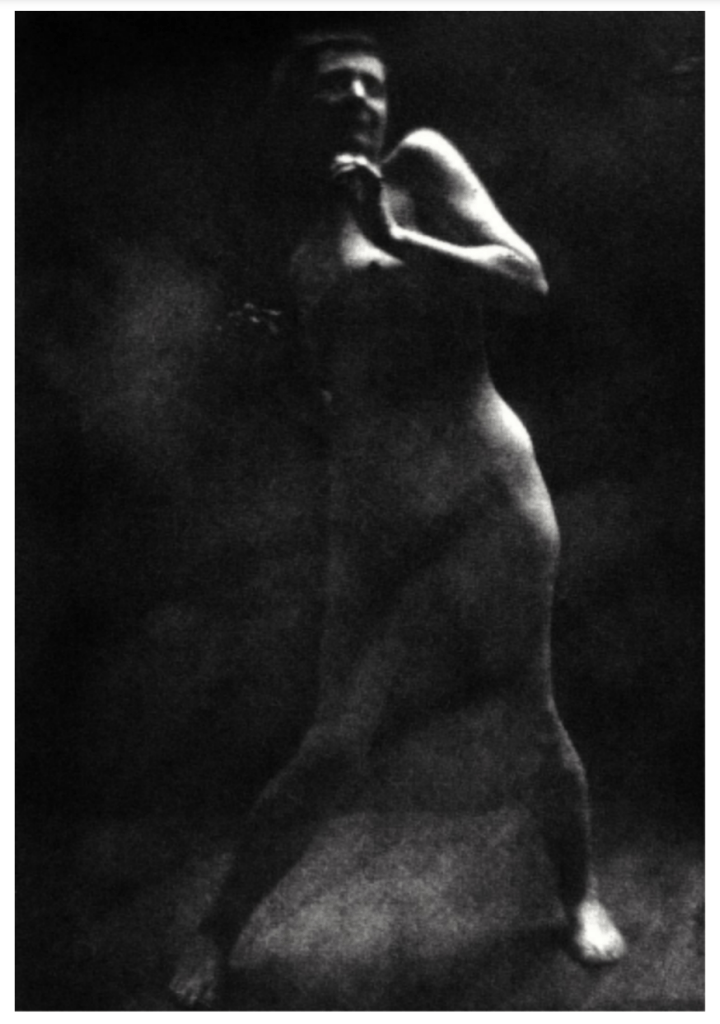
Elsa von Freytag-Loringhoven (1920).
Elsa von Freytag-Loringhoven Papers, Special Collections and University
Archives, University of Maryland Libraries
© Man Ray Trust/ADAGP (Paris) / SODRAC (Montreal)
Likely from a shoot of “Elsa, Baroness von Freytag-Loringhoven, Shaving Her Pubic Hair” (1921)
¶¶¶
The Baroness
Mimosa House
27 May – 17 September 2022
Wednesdays to Saturdays, 12-6pm
A group exhibition dedicated to Dada artist, the Baroness Elsa von Freytag-Loringhoven (1874–1927), alongside contributions by Nora Gomringer, Libby Heaney, Caspar Heinemann, Istanbul Queer Art Collective, Zuzanna Janin, Reba Maybury, Sadie Murdoch, Nat Raha, Taqralik Partridge, Liv Schulman, Astrid Seme, and Linda Stupart.
Elsa von Freytag-Loringhoven was “the first American Dada”, “New York’s first punk persona”, “the great aunt of feminist performance art”, and a radical poet and assemblage artist. Her assemblages and costumes included everyday objects: teaspoons, stamps and tomato cans. Her poetry touched on the subjects of gender and sexuality, religion and war, disrupting patriarchal and gender codes, and reclaiming women’s right to pleasure and birth control.
Grotesque, provocative, non-acquiescent, eccentric, anarchic, von Freytag-Loringhoven’s work shares the vocabulary of Dada itself. However by including her own body and very personal motives in her poetical work, the Baroness creates a very distinct interpretation of Dada and anticipates the post-modernist movement. Born in Germany in 1874 as Else Plötz, the future Baroness Elsa von Freytag-Loringhoven left home at age 18 to work as an erotic vaudeville artist and an artist’s model in Berlin and Munich, before relocating to New York and Paris to pursue her poetical and performative practice. She published her poems in the uncompromising
Little Review arts magazine, sparking outrage for their experimental form and provocative subject matter, gaining recognition and admiration from leading figures of high modernism such as Man Ray, Ezra Pound, William Carlos Williams, Peggy Guggenheim, Berenice Abbott and Ernest Hemingway.
Despite its radicality and innovation, the Baroness’ work remains unfamiliar to the wider public. The Baroness at Mimosa House will present her original works in the UK for the first time, in dialogue with contemporary artists and poets, celebrating her revolutionary vision of gender and feminism.
 c blog
One response to “The Fountain’s mystery”
Concerning the shape of the “R” in Elsa’s handwriting and its deviation from the “R” in the Mutt signature: try writing your name in capital letters with a brush and oil paint on a smooth porcelain surface and you will see that you will not be able to reproduce your handwriting. This takes a lot of practice, which “R. Mutt” surely did not have. In any case, whoever did the “signing” was not trying to reproduce either their name or handwriting.
As for the wording of Duchamp’s April 11, 1917 letter to Suzanne: the verb “envoyer” should be understood in the sense of “submitted” or “sent in”. The term “envoi” can refer to a submission to an art exhibition or competition.
LikeLiked by 1 person