
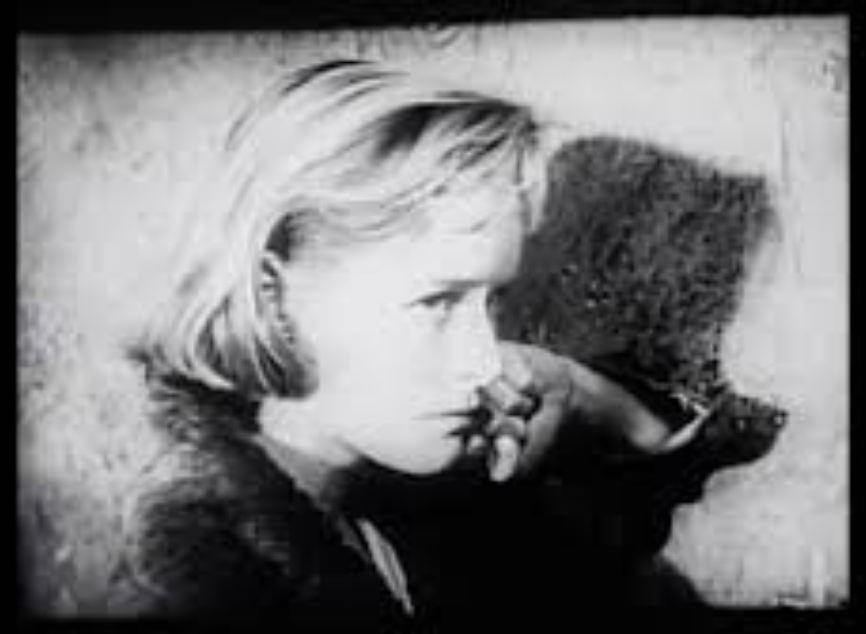
Woman, Ukrainian, Jewish, Esfir Shub was an absolute pioneer in filmmaking created from documentary film archives. She was thus a forerunner of Soviet cinéma vérité (Kino-Pravda, Dziga Vertov, and others), analytical documentary cinema, and the so-called essay film.
Faithful to the avant-garde logic of Soviet agitprop at the dawn of a revolution that took Russia out of the Middle Ages and led much of the world’s progressive intellectual elite to dream of “socialism in one country,” this revolutionary editor and film censor developed a technique of cinematic narrative that, in its intricacies, is not very different from Cubist collages.
This afternoon, I watched Velikij Put (The Great Road) at the Cinematek in Brussels, an extraordinary film series selected by Billy Woodberry, an American living in Lisbon and one of the leading directors of the L.A. Rebellion. What impressed me most about this film was its great virtual proximity to one of the most important, mythical, and tragic events of the 20th century—the Russian Revolution. This film manages to bring that event remarkably close to the viewer. It is a remarkable propaganda piece, but that does not prevent it from being a noteworthy conceptual artwork.
In this era of assumed post-truth in which we live today, a film like this raises crucial questions about the role of art in the age of technical reproducibility and manipulation of information and representation. Even in its construction, although the narrative is the result of a collage of pieces of film rescued from archives, there was a need to film printed materials to complete the meaning of the images captured from reality. In other words, this is not a film made from memories—distracted or intentional—of hidden cameras, but always and still a representation.
This film provides yet more proof that anti-cinema exists, just as anti-matter does. I wonder whether anti-cinema, like anti-art, does not deserve a place in the Parliament of Others and the Museum of Others.
#
Esfir Sub
Velikij Put (The Great Road/ Le Grand Parcours)
USSR 1927
115′
Une monteuse virtuose, faisant jaillir sa vision de l’histoire, à partir de documents rares, réunis lors du dixième anniversaire de l’Etat soviétique.
Cinematek
#
Velikiy put
The Great Road
Esfir Shub
Union of Soviet Socialist Republics 1927
114 min
“It is amazing how many unexpected solutions come up when you hold film stock in your hands. Just like letters: they are born on the top of the pen.”, found footage pioneer Esfir Shub once succinctly described her method. Having joined the state company Goskino in 1922 as an editor, Shub at first was in charge of rendering foreign film imports picked up for Soviet distribution (including Chaplin’s Carmen and Fritz Lang’s DR. MABUSE) “suitable” for national audiences. Shub’s extensive work in editing led her to discoveries that influenced directors like Eisenstein, Vertov, and Pudovkin, but her official breakthrough came with the commission to make a film commemorating the 10th anniversary of the October Revolution, effectively starting her career as a compilation filmmaker working mostly with newsreels gathered from all over the globe. Culled from documentary material, her October Revolution film THE FALL OF THE ROMANOV DYNASTY (1927) demonstrated Shub’s “intention […] not so much to provide the facts, but to evaluate them from the vantage point of the revolutionary class. This is what made my films revolutionary and agitational – although they were composed of counterrevolutionary material.” But her masterpiece became the follow-up THE GREAT ROAD, in which she chronicled the years from 1917 to 1927 according to her compilation method, including material she had to shoot herself (of old documents, photographs, newspapers, etc.) because “after the Civil war Soviet newsreels concentrated on parades, meetings, arrivals, departures, delegates and the like, while there was almost no record of how we transformed the country to a new political economy.” (Christoph Huber)
— in https://www.viennale.at/en/film/velikiy-put
#
Esfir Shub
[…]
The Fall of the Romanov Dynasty (1927)
The Fall of the Romanov Dynasty (1927)
In 1927, Shub released her first documentary, Padenie dinastii Romanovykh. She was commissioned to commemorate the tenth anniversary of the October Revolution.[10] and to provide the first visual record of the Russian Revolution. The Fall of the Romanov Dynasty is one of Shub’s most famous surviving films and what many film historians classify as the first compilation film or Soviet montage. Originally titled February, screenwriter Mark Tseitlin and Esfir Shub collaborated on this documentary-style film centered around the decline of the Russian monarchy.
The movie is made up of stock and archived footage that Shub meticulously preserved and reused. Shub travelled to Leningrad in 1926 to obtain the footage she needed for the film, spending two months examining more than 60,000 meters of film (much of which was damaged) and choosing 5,200 meters to take back to Moscow. The film spans the years 1912 to 1917, recounting the events leading up to, during, and following World War I, culminating in the October Revolution. It is notable for its use of intertitles, which provide historical context and commentary on the events depicted in the footage as well as help guide viewers through the beginning of the end of the Romanov dynasty. This technique, along with her portrayal of the Romanov family, effectively demonstrates the stark contrast between the lavish lifestyle of the aristocracy and the struggles of the working class. Film theorist Alla Gadassik suggests that without her intervention in “sourcing, untangling and preserving neglected rolls of film, it is highly likely that none of this footage would survive the following decades.”[11] Shub’s contribution to the history of compilation film was influential in the United States in the 1930s and during World War II. Historians Jack C. Ellis and Betsy A. McLane note that “nothing like Shub’s films had existed before them, and her work remains among the finest examples of the compilation technique.”
Critical reception
Eisenstein’s October(1928), which was also commissioned for the tenth anniversary of the event, was criticized by LEFists (Soviet art journalists), for being ‘too personal,’ while deeming the impersonality of Shub’s work more exemplary for the Revolution. Soviet film theorists praised Shub’s invisible authority as truly revolutionary, for it was consumed effectively as propaganda. Sergei Emolinsky, a constructivist critic associated with the Soviet art journal LEF, praises both Shub and Vertov equally for their different attitudes towards documentary film. He explains that while Vertov threw himself on the given material, cutting it into numerous pieces, thus subordinating it to his imagination…Shub regarded each piece [shot] as a self-sufficient, autonomous entity.” This first-hand critique of the two methods indicates that Shub’s dedication to journalistic cinematography was the catalyst for what documentary film classifies today as compilation film.
 c blog